.png)


Oblivion
Douglas Barrett (2026)
OBLIVION
A Retrospect of Works by // Douglas Barrett
A collection of lonely places and the solemn melancholy of the past.
When does a building or space take on the emotive property of a portrait, rather than merely the documentation of buildings within the landscape? The fleeting moments of the golden hour. The hum of a single fluorescent tube. A rural location mixed with evidence of commerce all speak about the lives of spaces from a not too distant past. Evidence of where we have been... seen in the rear-view mirror of the mind.
--
Professor Douglas Benjamin Barrett, of Birmingham, Alabama, passed away July 29,
2026. Gone far too soon, he leaves behind a legacy of creative brilliance, rigorous
critique, devoted mentorship that shaped generations of designers, and lasting
memories with all who were fortunate enough to be a part of his life.
Born November 5, 1962, in Greenwood, Indiana, he was the youngest of four sons of
Howard and Betty Barrett. In 1969, the family moved to Orlando, Florida. Growing up in
Orlando, Doug enjoyed the beaches and springs, keeping company with a close-knit
group of friends, and driving his 1965 Mustang convertible.
He was hilarious, charmingly direct, and supportive of all who came into his life. Humble
to the core, Doug did not want others to worry about him. Instead, with such
genuineness, he took care of others and encouraged their passions and skills. Truly
adored, he was the type of person everyone couldn’t wait to spend time with. Having
Doug home in Orlando for the holidays was a treasure for his family, as he was such a
fun, joyful light.
Following in his father’s footsteps, Doug demonstrated his impressive artistic ability and
incredible eye for design early on. He received his MFA from the University of Florida
(UF) and a BFA from the University of Central Florida. He had more than 20 years of
professional graphic design experience, working for agencies and as a principal in his
own design firm, Rodon & Barrett, Inc. His list of international clients included Mars,
Inc., VISA International, and Banco Popular. He directed Bloom Studio at the University
of Alabama at Birmingham (UAB), an invitation-only, independent study class where
design students gain real-world experience working directly with clients on Design for
Good projects. Past projects included Cahaba River Society, Bibb County, Lakeview
District, Southern Research, and the Village Creek Society, to name a few. His creation
of Bloom Studio is proof that Art and Design can be a core conversation in building
infrastructure and equity in communities. Bloom Studio students use ideas of
collaboration, innovation and creativity to propel the community towards remarkable
accomplishments. Doug and Bloom fostered students on their trajectory towards
outstanding careers and futures, not only as artists, but also as thoughtful, expressive,
caring, community-engaged adults.
He was recognized as one of the University of Florida's Graduate Teachers of the
Year in 2006, and co-directed UF's Tokyo Study Abroad program from 2008-2010. In
2013, Doug received a $47,000 Sappi Ideas that Matter Grant – one of only 13
designers awarded to help create and implement print projects for charitable causes. In
2012, he was awarded a prestigious Alabama State Arts Fellowship in Design. In
2014, he was the recipient of the SECAC Awards for Outstanding Professional
Achievement in Graphic Design, and in 2016, he was awarded the UAB President’s
Award for Excellence in Teaching. In 2023, Doug’s work was recognized as one of the
50 best book covers for 2022-2023 by the American Institute for Graphic Arts (AIGA).
With 487 entries from 27 countries, AIGA 50 Books | 50 Covers competition recognizes
and showcases excellence in book design from around the world. As a winner, his work
was added to the Rare Book and Manuscript Library at Columbia University’s Butler
Library. Doug also exhibited his work both nationally and internationally.
His research interests included commuting, space and place, and typography.
Fascinated with the practice of commuting, the allure of the roadside, and local
visual culture, Doug was interested in exploring and representing found text and
imagery in a way that talks about the constructed place. Signage, billboards, graffiti,
and ephemera point to the visual culture embedded in our surroundings. By
examining the details of roadside culture, he explored how meaning is constructed
and conveyed through visual and cultural relationships.
Doug was loved by his students and worked hard to help them build successful careers
and develop as thoughtful artists and professionals. He was thoughtful in the ways he
served and committed time to UAB working in departmental and university-wide
programmatic assessment, and was instrumental in founding the UAB Department of
Art and Art History’s new Graphic and Digital Design concentration. He was known as a
distinguished faculty member, who navigated the great challenges he met with elegance
and humility. Deeply respected by colleagues, students, and the broader arts
community, his contributions to the university will have a lasting impact. He inspired
hundreds of alumni who went on to lead creative agencies, have wide and diverse art
and design careers, and teach at universities globally.
Doug is survived by his brothers Marcus, Paul and his wife Melinda, and Michael; his
nephews Bradley and his wife Celina, Evan and his wife Krystal, Rory and his fiancé
Christina, and Allen. He also leaves behind countless extended family members,
friends, students, and colleagues. He was predeceased by his beloved parents Howard
and Betty, and his furry companion, Kirby.
The influence Doug had on all who were lucky to know him is immeasurable. He will
continue to live on in our hearts, and in our art.
In lieu of flowers, the family requests you make a donation to the American Cancer
Society or Magic City Wellness Center in Doug’s honor.
“Dear brother, wherever you go, go with all of your heart.”


Ley//\\Lines
Franklin Jeffers (2026)
Artist Statement:
Ley //\\ Lines examines the overlapping architectures of higher education and incarceration through sculpture, installation, architectural mapping, and mediated image-making. Drawing on aerial perspectives, institutional layouts, reconstructed landscapes, and circulation systems, the work investigates how structures of power become embedded in the built environment and internalized through movement, routine, surveillance, and classification.
Working across ceramic, mixed-media installation, print processes, video, and fabricated forms, the exhibition constructs fragmented spatial narratives that reference both literal and psychological infrastructures. Satellite imagery, site plans, reconstructed terrain, and distorted architectural references are translated into sculptural environments that oscillate between documentation and abstraction. Arrangements of 3D-printed elements within fabricated landscapes mimic aerial viewpoints, while suspended forms, containment structures, and unstable balancing systems suggest the constant negotiation between control and vulnerability.
Rather than presenting institutions as separate entities, Ley //\\ Lines examines the visual and structural parallels among spaces associated with discipline, education, observation, and social organization. The work reflects on how institutional systems shape identity, visibility, and access, while questioning the permanence of imposed classifications and the architectures that sustain them.
Through fragmented mapping, repeated material, and mediated imagery, the exhibition explores the lingering psychological residue of institutional space and the invisible pathways that continue to link sites of confinement, scholarship, authority, and belonging.
Bio:
Franklin Jeffers is an Oregon-born interdisciplinary artist based in Alabama, whose work examines systems of institutional power, surveillance, spatial control, and the psychological residue of the built environment. Working across sculpture, ceramics, installation, print processes, video, and mixed media, Jeffers constructs fragmented architectural and landscape-based forms that explore visual parallels between spaces of confinement and higher education.
Drawing on experiences navigating institutional systems as a system-impacted individual, Jeffers’ practice investigates how structures of authority shape identity, movement, visibility, and belonging. Influenced by architectural mapping, mediated imagery, and critical theory, his work often employs aerial perspectives, reconstructed terrains, and material repetition to examine the intersections of memory, bureaucracy, and social organization.


Siete Vidas
María Korol (2026)
Artist Statement:
A deep engagement with history and literature leads me toward speculation: imagined realms where shifting perspectives and multiple possibilities distort and transform reality. Through drawings, paintings, clay sculptures, writing, and animations, I tell uncanny stories about impossible, humorous, and eccentric creatures. My mantra is simple: the weirder, the better.
A phenomenon known as pareidolia guides my image-making process, allowing critters and forms to emerge directly from the materials as I push and pull them—inviting surprise, tension, and transformation. Anthropomorphism, in turn, becomes a way to recognize ourselves in other bodies, challenging assumptions based on appearance and dissolving the distances that separate us—from one another, and from flora and fauna.
Through slow observation and attentive listening, I seek to reveal a reality where the sounds of animals in the landscape are not background noise but the central rhythm of life. A choreography of care and protection becomes the dance my invented creatures perform to that song.
Short Bio:
In her drawings and paintings, María Korol mixes an interest in history and literature with fantastical renderings of varied creatures in fluid transformations. In his review of María Korol’s 2023 solo exhibition “Bichos” at Marcia Wood Gallery, critic Sean Carney wrote in Artforum: “Via anthropomorphization, Korol has injected these bestial tableaus with humanity’s patently unfunny pecking orders of class, gender, and race.” Born in Buenos Aires, Argentina in 1980, in the middle of a military dictatorship, Korol was exiled to Brazil for five years and later returned to grow up in her home country. She moved to the United States in 2004. She has shown her artwork nationally and internationally in places such as MARCH Gallery in New York City; Institute 193 in Lexington, KY; Indigo + Madder in London, UK; Cluster Contemporary in Rome, Italy; and the Akademie der Künste in Berlin, Germany, among other places. She is a distinguished fellow of the Junge Akademie der Künste and the Hambidge Center. In recent years, she was a finalist for the Atlanta Artadia Award and the recipient of the Edge Award with the Forward Arts Foundation. Her work has been mentioned in The New York Times, Artforum, Atlanta Magazine, Art Papers, Burnaway, and ArtsATL. Her studio is based in Atlanta, Georgia, where she is an associate professor of visual arts at Morehouse College.


Homespun Transcendence
Amy R. Peterson (2026)
Artist Statement:
I created these works at a time of great transition and a bout of depression. For years, I had poured myself more and more into my teaching and other aspects of my life, and less and less into myself and my artistic process. I found myself thrilled to do a joint show with a mentor artist of mine in 2025, but I lacked a focus for the subject matter to paint with all the enthusiasm I wanted to bring to a new body of work. Stylistically, in my art, I was also in transition. But the lack of painting time had left me without a sense of direction. I wrestled with what to do for some time. Ultimately, the answer became very clear: Paint what's most precious to you right now. Paint what you know and love. Paint what grounds you and lifts you! So, I spent much of the spring and summer of 2025 painting home and family; the style or aesthetic and the application of paint naturally worked itself out through the creation process. Trust the process, as they say! These paintings capture glimpses of my home and family life, fleeting encounters with peace and joy amidst a breakneck schedule and mental load of this time in my life. These paintings are reminders to slow down and be present, or else miss all the magic! On the surface, we see the messiness of everyday life, but when looked at with love, an everyday moment becomes transcendent.
A Short Bio:
Amy R. Peterson is an artist and art teacher, a wife, and a mother of 3 children. She is a lover of art, music, animals, nature, architecture, antiques, outdoors, travel, and people (but leave the ego at home). She lives near her native Birmingham, Alabama. She is a wife and mother of 3 children, and a sister and an aunt to many. Her artwork has been featured in regional and national exhibitions by the American Impressionist Society and Oil Painters of America. She is represented by Beverly McNeil Gallery in Birmingham, AL, and Crown Gallery in Blowing Rock, NC. While she worked other jobs, she used to fantasize about where an art career might take her life; now she smiles at where her life takes her art!


Seven Summers
Daniel White (2026)
Artist Statement:
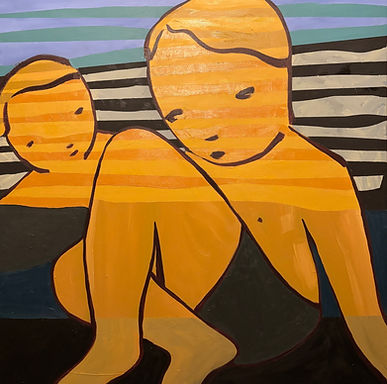
Seven Summers is a collection of bodies of work by Daniel White over the last seven years the artist has lived in Tuscaloosa County, with summer often being as a season of strong studio or exhibition activity.
Shaped by his background, White’s paintings bring together illustrative aesthetics to create work with a sense of childlike wonder and an unguarded sense of humor. His paintings are constructed through a weaving of allusions, references, and citations from the figurative tradition. He reinvents the conventional within a narrative context and historic muted palettes, coming from a time that’s not quite identifiable but familiar, nonetheless. Woven into his works are stories of lake memories, family legends, personal narratives, and supernatural experiences. They are warm, humorous, quiet, and deceptively complex.
Ceramics has played an important role in the artist’s life and work. Originally a painter, he was enamored with the ceramics process, and after a years long hiatus to focus on painting, he has recently returned to the medium. White credits ceramics with helping build his illustrative vocabulary and emphasizing texture in his paintings.
By exploring playful informality and self-reflection on the formal structure of oil paint and its formal history, White brings playfulness to an often otherwise serious medium. The result is complex simplicity, focusing on its most essential elements. Remnants of memory, truths, and half-truths are layered into landscape or portraits. Whether it is factual or not, it is of no importance, as eventually memory delivers the same sleight of hand for all of us.
Bio:
Daniel White was born in Birmingham, Alabama on May 28th, 1975. He serves as the Museum Director of the Paul R. Jones Museum, and the Gallery Director of The University of Alabama Gallery in Tuscaloosa, AL. Trained in studio art, he holds an MFA from RIT- The School for American Crafts, and a BFA from the University of Montevallo in Montevallo, AL. His work can be found in collections across the United States. He lives with his family in Northport, Alabama.


Waiting Room
Sonja Langford (2026)
Artist Statement:
Waiting Room considers the emotional and physical experience of moving through medical
systems that demand explanation, proof, and patience from the body. Drawing from medical
archives, histories of gynecology, and personal experience with illness, the exhibition focuses
on the uncertainty that exists between being observed and being understood. The work
reflects on waiting as a condition shaped by institutional care: waiting for answers, waiting for
language, waiting to be believed. Throughout the exhibition, attention is placed on what
medical records cannot fully hold and on the gaps between lived experience and official forms
of knowledge.
Bio:
Sonja Langford (b. 1994, St. Augustine, Florida) is an artist and researcher raised in the
American South. She received her MFA from the University of Connecticut and holds a BA in
Art History from the University of North Carolina Charlotte. Her interdisciplinary practice
encompasses photography, bookmaking, social practice, and installation, all exploring the
intersections of medical history, gender, and power. Through her research on American
gynecology, Langford investigates how past narratives shape present realities, illuminating the
silences and structures that persist in contemporary healthcare. Her approach is informed by her
background in facilitation and leadership education, grounding her studio practice in
collaboration, reflection, and collective meaning-making. Sonja’s work has been exhibited
nationally and supported by exhibitions, residencies, and curatorial projects that bridge research,
care, and community, including the Aldrich Museum of Art, the Mattatuck Museum, and the
McColl Center.


Weather Patterns
Alexa Lee (2026)
Artist Statement:
This body of work began with the series A Record Year for Rainfall. In these paintings, the subjects of the images are soaked through and don’t seem to recognize that it’s raining. These images explore grief through the lens of weather, namely through a sense of uncanniness—of something not being right, every day, all the time. I find this feeling, this experience of grief, to be extremely isolating; no one else seems to be able to fully see or understand the ever-present heaviness. Except, perhaps, all the other people are also walking through grief. A Record Year for Rainfall expresses this sense of isolation, yet there is commonality between the imagery of all the rain paintings, hinting at the hope of community, that the subjects might not be as completely alone as they feel.
I find the painting You Tethered Me to You to encapsulate the shift between the rainfall paintings and the work that follows. Two of the subjects of the rain images have found a way to exist in the rainstorm together. A couple of years ago, when I began painting the work in this exhibition, I was in a place of deep loneliness. But as time progressed and seasons changed, I found community with others who felt the world as I feel it. I also met my husband through those years. It started as both of us getting close enough to recognize something we understood in one another, what we now refer to as “a mountain of loneliness.” And over time, the mountain began to thaw into something warmer, something not without pain, but an experience of connection and love that I am still trying to wrap my head around; something I never actually believed I would find. The second half of the artwork is about this “shift in weather” and my attempt to understand it. It is an attempt to capture and hold onto what can’t be held, as weather will change and time will continue to pass. I hope the humanness of this body of work is something that the viewer can recognize, that they can find themselves somewhere in these images.
Bio:
Alexa Lee is an oil painter and ceramic artist based in Birmingham, AL. She has been featured in exhibitions across the Southeast United States, including the Montgomery Museum of Fine Art, the Meridian Museum of Art, and the Gadsden Museum of Art. She studied at the University of Alabama at Birmingham and graduated with a BFA degree in 2024.
Alexa’s work focuses on memory and how it embeds itself into the body and mind. She primarily works in the genre of narrative figure painting, depicting subjects frozen in dreamlike scenery, as well as eerie landscapes and still lives which border on the surreal. Her style is influenced by artists of the Impressionist and Romantic movements, including James McNeill Whistler, John William Waterhouse, and Mary Cassatt. Alexa is also a ceramicist and uses clay to create functional vessels and sculptures that imply narrative within their form and express the fragile nature of the human condition.


The Little World
Elaine Bowman (2026)
Artist Statement:
Every day, most of us go about our business, never noticing the “little” world that co-exists, nestled inside our big world. As someone who enjoys nature, I started to notice the “little world” when I purchased a macro lens and decided to try and photograph some of the beauty I see every day, right outside my front door.
There is so much splendor right outside our front door. We walk by it every day and yet don’t see it. We take so much for granted; we get lost in the hustle and bustle of daily life; we forget to slow down and take a minute to just “see” all of the beautiful things that are all around us. Nature provides us with elegant, funny, and special things to look at if we just take a minute to stop and slow down.
All of us need a little bit of “special” to come into our lives. I tried to capture some of those special things to share – all we have to do is stop, look around and take the time to appreciate the little world right outside our doors…
Biography:
I am is a local photographer and artist. I served in the United States Air Force for over 30 years. While I was stationed in Ankara, Turkey, I became interested in photography. While working with the base photographer, I learned the basics of film photography, including darkroom techniques, while developing my own film. After retiring, I decided to go back to school – I started out at Gadsden State Community College. I started taking art classes there; Alan Curtis helped me move to digital photography and gave me my first taste of working with digital cameras and photo software. I transferred to Jacksonville State University and earned my Bachelor of Fine Arts degree in 2021. My concentration, of course, was Photography. I also earned a Master of Arts at Jacksonville State University.
Since graduation, I still take my camera out on a regular basis. My love of photographing insects and “little creatures” came when I bought a macro lens, took it outside, and started to learn what it could do. Many of the photos in this exhibit are because of that lens.
I hope anyone who sees the photographs in my exhibit enjoys what they see; but mostly, I hope they inspire people to slow down, put down the device and take a long look around – some of the most beautiful things in the world are right outside our front doors, if only we take the time to look.


Yes, Absurd
Ground Floor Contemporary (2026)
Participating Artists:
GFC ARTISTS
Mary Anne Arntzen, Sara Garden Armstrong, Matthew Barton, Heather Baumbach, Sarah Bell, Misty Bennett, Patty B. Driscoll, Catharine Friend, Renee Hanan Plata, Meg Howton, Elaine Farley Kinnaird, Annieo Klaas, Sophie McVicar Tate, Ryan Meyer, Bethany Moody, Catherine Nelson, Miriam Omura, Elisabeth Pellathy, Serena Perrone, Kyle Riley, Elizabeth Russell, Shori Sims, Tara Stallworth Lee, Chiharu Takahashi Roach, Rebecca Tully Fulmer, Jennifer Wallace Fields, Sarah West
21st STREET STUDIO ARTISTS
Florence Blair, Nancy Carney Barnhart, Melanie Grinney, Darius Hill, Mary Grace Wolnski
yes, labor-intensive; yes, repetitive; yes, action; yes, meaningless; yes, urgent; yes, unsellable; yes, funny; yes, heavy; yes, time-consuming; yes, ugly; yes, gorgeous; yes, macabre; yes, weird; yes, found materials; yes, nature; yes, bodily; yes, communual; yes, solitary; yes, unpractical; yes, subversive; yes, playful; yes, boring; yes, frivolous; yes, yearning; yes, nothing; yes, absurd
The title stems from the term “tactical absurdity,” coined by the artist and writer Dave Ball. This show reflects how we each embrace and revel in the absurdity of making art, and, at times, utilize absurdity and related substrates as mediums.
GFC Artist Talk - Video Link: https://youtu.be/IzJosRkA5G4


What Are Dreams If Not Hostage Situations
(2026) Alabama Contemporary Art Center is sponsoring a curated show by Mat Keel and Liz Lessner as Yes We Cannibal. This collaborative exhibition will feature works from artists: Jak Ritger, Jonathan Peterson, Lily LaGrange, lmfs (Louisa Minkin & Francis Summers), Tunde Wey, and Panacea Theriac.
What Are Dreams If Not Hostage Situations?
The dream speaks clearly. Its language is dazzling. It says: “This is not that thing, it is another thing.” Can you even imagine? Well, I wouldn’t dream of it. The things in the dream say: “I am not that one, I am that other one.” They storm the room and bar the door. Here you are.
“To dream that you are a hostage indicates that you are feeling victimized or powerless. You feel limited in your choices or physically immobilized. Alternatively, to dream that you are a hostage suggests that a part of yourself is not fully expressed.” –Dream Dictionary, The Internet, 2026.
You were there last night. In my dream. And you, and you, and you. It was a party.
A temporary restaurant named Can-I-Ball? with executive chef Tunde Wey at Yes We Cannibal in the Spring of 2023. Restaurant patrons are required to wear bubble suits and don matching masks; they are attended to by a pair of hostile paramilitary figures and served a seven-course meal prepared by a disembodied chef who assigns conversation topics about death, embarrassment, and other forms of anomie. Diners can respond to these prompts only by asking the servers to speak on their behalf; turned inside out, reconfigured, made into dadaist figures performing as diners enmeshed and implicated in absurd systems. One guest later relays telling a friend about the experience over the phone, and how the friend finds it all so odd that she assumes the guest has been explaining a dream.
What Are Dreams If Not Hostage Situations? offers a series of interventions and a repertory of mesmerizing action figures for our new horizon. They investigate the origin of the episteme: videos by LMFS in which digital oracles present the dark creation myth of their own emergence from a sea of anomie and kitsch. They study its economy: photographs by Lily LaGrange wherein the trinity of a magician, his props, and his assistant jointly testify to the eternal productivity of magic. They invent time: photomontages by Jak Ritger transmuting industrial architecture in to gravestones for a timeline of technology. They probe the integrity of the structure: sculptures by Panacea Theriac’s in which the ceramic vessel merges transience and matter, new simulacra of the puppet on which it is modeled. They archive without ever recording: Jon Peterson’s photographs introduce the fine dining guest as hostage, and possibly, slave or political martyr. They surface the monster: Tunde Wey’s performance artifacts mutate the topology of small gastronomic pleasure into vectors for neo-colonial systems of extraction.
We are liberated now. It’s time to get some sleep, per chance to dream.
----
More about the Artists:
JAK RITGER
Jak Ritger is an artist and theorist living in Allston, MA and based online. His 2020 essay "On Devirtualization" helped popularize the term for 'meeting an internet friend IRL' as a way to describe aspects of contemporary life, aesthetics and the architecture. His photography work was exhibited at Fountain Street Gallery & Hammock Gallery in 2020. Ritger is one half of the concept-driven video-direction and production team TRLLM (DIIV, Kim Gordon, Boys Noize & Pussy Riot). He is a core member of the New Models and Do Not Research online artist collectives and his writing on technology and mass social phenomena has been published by outlets such as Dazed Digital, Kaleidoscope, King Kong, Ocula and DIS.art, among others. In 2022, he co-wrote "Astroturfs of Offense" a tactical media map and glossary of tools for political persuasion. In 2024, he participated in an exhibition at Fall River Museum of Contemporary Art in Massachusetts that saw Ritger create a room-sized site specific installation of vinyl detailing the history of fourth dimensional thinking and local para-history. Last year, he helped produce a photo editorial by Loretta Fahrenholz titled "Dalí Boheme" for Novembre Magazine that merged street photography with early surrealist poses and AI-generated photogram textures as well as participating in an exhibition in Geneva, Switzerland with a photography and vinyl installation titled "Spooky Action At A Distance." This year, he has exhibited at Pharmakon in Bucharest, RO as part of the "Man-made Horrors Beyond Comprehension" group show centered on the work of David Dees, an artist that defined the visual language of conspiracy theory media. Ritger shares his artwork and writing on his blog, Punctr.art.
----
JONATHAN PETERSON
Jonathan Peterson (b. 1985) studied photography at Louisiana State University and Texas A&M- Commerce, eventually graduating from LSU with a bachelor’s in art. He returned to LSU in 2021 where he recently completed an interdisciplinary master’s degree in 2023. His research revolves around behavior analysis, creativity, and the liberal arts educational ethos. He is currently in the third year of a photographic project exploring the linkages between memory, mythology, and environment through the landscape and place of South Louisiana.
----
LILY LAGRANGE
Lily LaGrange (b. 1997) is an artist working with photography, sculpture, text, and installation. Her work explores magic, power, and access to/mastery of the supernatural. She received an MFA from Syracuse University in 2024 and is currently based in New Orleans.
----
LMFS
Louisa Minkin
Situated at the interface of archaeology and gaming, my work disrupts conventions of artistic and social production, and builds new communities. I work on the adoption of 3D imaging into art practice. Data objects and algorithmic cultures produce entirely new paradigms for artists, dissolving conventional disciplinary boundaries, producing temporal slippages and material problems. If digitised pre-historical objects take on new lives, economies and qualities, and post-historic (contemporary) informatics cultures produce new materialities and collectivities, then my research seeks to articulate the interplay between the forensic practices of archaeologists and the pathologised spaces, weaponised imaging and vernacular modelling of gaming communities.
Francis Summers
Dr Francis Summers is an artist and writer. He has studied at Wimbledon School of Art, the Courtauld Institute and the Royal College of Art, with degrees in Fine Art, Art History and Photography. He has worked across photography and video, with an interest in appropriation, time-based media and subjectivity. He is interested in thinking about ways to explore photography as both a formal image-making technology and a communicative tool that cuts across a number of fields of social and aesthetic practice. Recently he has worked in collaboration with Louisa Minkin, as lmfs, on a number of projects looking at anomie and the digital, exploring banner forms and experimental writing. Recent publications and lectures address the work of Jenn Nkiru (situating her film ‘Black to Techno’ through Kodwo Eshun’s writings on Afrofuturism and Christina Sharpe’s notion of the Wake), the collage of Linder (in terms of feminism, festivity and food) and the fashion work of Hood By Air (looking at fashion as the performance of the sexual via the queer theory of Tim Dean and the psychoanalytical lens of Alenka Zupancic).
----
TUNDE WEY
Tunde Wey is a Nigerian social practice artist using food, finance and investment capital to address economic disparities across geographies and demographies. His work engages systems that create material disparity, focusing particularly on how economics and finance impact working class Black people globally. Tunde uses performance and installation, film, food, writing and finance to confront disparities in material conditions and attempt interventions to address these socially constructed inequalities.
Wey's work has been featured in The New York Times, NPR, GQ, The Washington Post, VOGUE, Black Enterprise, Food and Wine, and his writing has appeared in the Oxford American, Boston Globe, San Francisco Chronicle, Roads & Kingdom and a couple cookbooks/ anthologies. His docuseries is a 2024 CANNESERIES Official Selection. Tunde is a recipient of the Monroe Fellowship from Tulane University (2023) and the Ford Foundation Just Films Grant (2022). He is currently working on a book of essays to be published with MCD (a division of Farrar, Straus & Giroux).
----
PANACEA THERIAC
Panacea Theriac, also known as Miss Pussycat is based in New Orleans. She is a puppeteer, performer and artist who creates puppet shows and plays maracas alongside Quintron in their band Quintron & Miss Pussycat. Panacea began her puppetry work as a child in Antlers, Oklahoma, as part of her church’s Christian Puppet Youth Ministry. She has performed puppet shows in rock clubs, libraries, art spaces, and basements around the world and has also created numerous puppet films and videos. Each of her puppets are treated as a distinct character with its own personality. In addition to puppetry, her visual art includes ceramics, paintings and photographs that create shrine-like tributes to her puppets and their worlds.
She has had numerous exhibits of her puppets and artwork, including the New Orleans Museum of Art, The Ogden Museum of Southern Art, the Contemporary Art Center in New Orleans, Galveston Art Center, Ohr O’Keeffe Museum of Art, Pensacola Museum of Art, Twin Steeples, and the Webb Gallery in Waxahatchie Texas.
Miss Pussycat has a new record coming out in April, called The Skit Split. It is a split LP with the band Evil Sword. Miss Pussycat’s side of the record is the soundtrack to her puppet show MG Xing Ever Gras. In June Miss Pussycat and Quintron have a west coast tour.
Panacea Theriac Videos:
PARTY PLANNING FOR ANIMALS - Live at the Sultan Room
https://vimeo.com/1143453585?share=copy&fl=sv&fe=ci
HOW TO MAKE A PUPPET SHOW
https://vimeo.com/405478760?share=copy&fl=sv&fe=ci


It Takes a Village / The Darkest Hour
Stacey Holloway (2026)
Artist Statement:
I am a visual storyteller. The form of the narrative has been used for centuries to entertain, to preserve culture and to instill morals. Stories can be used to bridge cultures, languages and age barriers. Similar to Aesop, my interests lie in the animal realm, and I use specific animal attributes to explore how our formative process make up who we might become, or who we are attempting to become. Within the animal kingdom, strong societies are formed within herds, unusual interspecies friendships and adaptation is required, pure instinctual capabilities are necessary for survival, and body language, sounds and scents are used to declare disfavor, profess love, announce dominance, and express pain. Bestial forms, found objects and installations then become the place for metaphors and narratives of uncertainty and longing.
The Darkest Hour explores the complications that a community/family might experience while supporting and assisting those with severe mental health issues. As someone who has close family members with mental and social obstacles, I have witnessed, not only the struggle of those family members, but also the toll that it takes on the rest of the family. The title, The Darkest Hour, refers to the saying “the darkest hour is always before dawn,” which means that the sky is at its blackest right before the sun rises or when times are at their worst, they tend to soon get better. This is a viewpoint that my family tries to take during some of our hardest times. Within this body of work, I use the symbolism of melanistic animals (having an abundance of melanin in the skin) and albino animals (having a lack of melanin in the skin) to represent the heartbreak, the isolation, the encouragement, the motivation, the knowledge, and the physical/mental struggle that takes place within such a household.
The It Takes a Village series explores the wide range of personalities, experiences, and identities that come together to form our families and communities. The title draws on the familiar phrase “it takes a village,” referencing our collective efforts and shared responsibility for support and success in our communities. We sometimes have a natural tendency to measure ourselves against others within the commonwealth to understand, relate, or find our place. However, each individual is shaped by a unique combination of background, culture, temperament, and lived experience, making direct comparison not only difficult, but often misleading. What may look similar on the surface can be fundamentally different at its core. By highlighting these contrasts, this series challenges the assumption that sameness is the standard by which we should judge one another. Instead, the series invites viewers to recognize difference as something essential rather than divisive. It suggests that understanding does not come from forcing parallels where none exist, but from acknowledging and respecting the individuality of each person. In embracing what makes us “uncomparable,” it celebrates the complexity that strengthens our relationships and enriches our shared communities.
Artist Bio:
Stacey Holloway received her MFA from the University of Minnesota in 2009, her BFA from Herron School of Art and Design/IUPUI in 2006, and has been living and working in Birmingham, Alabama since 2013. She currently serves as the Associate Professor of Sculpture at the University of Alabama at Birmingham. In addition to teaching, Holloway is an active national mixed media artist, sculptor, and fabricator that works within a variety of media including drawing, printmaking, sculpture, ceramics, and interactivity. Through the exploration of storytelling and ethology, she creates work that communicate a universal societal connectivity. Holloway has received distinguished awards such as the 2024 Artistic Excellence Award, the 2021 Visual Arts Fellowship through the Alabama State Council on the Arts, the 2017 SECAC Artist’s Fellowship, and the 2010 Efroymson Contemporary Arts Fellowship through the Central Indiana Community Foundation in Indianapolis.
Stacey Holloway Artist Talk - Video Link: https://www.youtube.com/watch?v=YJROT1C3rOg


Haitian Scenes
Berman Museum - Anniston Museums and Gardens (2026)
Haiti and the Bermans
Haiti’s artistic traditions are deeply rooted in the island’s complex history, shaped by Indigenous Taíno heritage, the forced migration of African peoples, French colonial rule, and the revolutionary struggle that created the world’s first Black republic in 1804. This blend of cultural influences produced a visually rich language steeped in symbolism, spirituality, and depictions of everyday life. The establishment of the Centre d’Art in Port-au-Prince in 1944 played a pivotal role in nurturing Haitian talent and elevating local styles, including Naïve Art, vernacular painting, and depictions of Vodou practice, to international prominence.
African aesthetics, European and American art traditions, and the visual practices of pre-colonial Haitian peoples influence modern Haitian art. In the mid-twentieth century, the Centre d’Art d’Haiti helped popularize Western painting techniques among Haitian artists while still celebrating uniquely Haitian subject matter.
Farley and Germaine Berman deeply loved Haitian art. Over the course of their lives, they visited Haiti numerous times and were moved by the art created there. This led the Bermans to collect many Haitian artworks, some of which are shown here.
Haitian Scenes is on loan from the Berman Museum, a component of Anniston Museums and Gardens.


True Colors
True Colors - Etowah County Board of Education (2026)
True Colors Arts Program was established in 2023 by the Etowah County Board of Education as a means of getting Art programming into schools that are often overlooked. This exhibition will feature student artwork from Ivalee Elementary, Southside Elementary, Glencoe Middle School, and Glencoe High School at the Gadsden Museum of Art. True Colors will be displayed until the end of May 2026.
Participating Students:
Kaiden Howard
Haven Blevins
Jaxon Pilkanis
Natalie Clark
Luke Yates
Charles Roden
Evie Cash
Gatlin Patterson
Skylar Blom
Eva Guthrie-Allen
Laisa Faal
Jessalyn Faal
Lucas Lee
Ben Johnson
Cayson Griffith
Rose Patton
TJ Abercrombie
Trinity Wilson
Alice Horton
Rae Brinley
Peyton Pierce
Brooklyn Crescenzi
Ally Rodriguez
Mia Hanson
Natalie Franklin
Sarah House (Ellie)
Ayanna Shockley
Samara Rice
Nathaniel Davis
Carter Ingram
Slayde Fulmer
Nevaeh Coshatt
Autumn DeArmond
Teresa Blue
Paxton Barfield
Shaun Ramon
Ahna Kay Massenburg
Adelyn Knight
Alyssa Moore
Tucker Garrard
Adilyn Johns
Chloe Young
Willow Hollis
Krimson Westcott
Bryleigh Bishop
Mary Kate Seagraves
Jenna White
Andee Skinner
Elizabella Skinner
Italy Ainsworth
Hayden Bullington
Josie Holt
Kiley Lloyd
Kairi Vigenwalt
Kira Estes
Ashlee Barber
Ciji Maddox


GMA Children's Show
GMA Children's Show (2026)
2026 Student Art Show Awarded Students
5K
1st place – Aiden Zeng
2nd place – Andi Freeman
3rd place – Andi Freeman
Honorable Mention – Symber Noojin
Honorable Mention – Natanael Perez Bravo
1ST GRADE
1st place – Ramsey James
2nd place – Delta Puttnam
3rd place – Aspen Cantellano
Honorable Mention – Carter Tilllman
Honorable Mention – Charlie Eubanks
Staff Pick – Delta Putnam
Viewer's Choice – Evan Armstrong
2ND GRADE
1st place – Sunny Sims
2nd place – Ivy Zeng
3rd place – Chloe Cook
Honorable Mention – Taylor Payne
3RD GRADE
1st place – Maddox Mashburn
2nd place – Hadley Mitchell
3rd place – John Nelson
Honorable Mention – Arric Riddle
Honorable Mention – Hadley Mitchell
Staff Pick – Harlow Wood
4TH GRADE
1st place – Hudson Hollis
2nd place – Shiloh Barnard
3rd place – Bentley Thompson
Honorable Mention – Zadok Noojin
Honorable Mention – Ayla Edgeworth
Staff Pick – Jamisyn Cargill
5TH GRADE
1st place – Sadie Landrum
2nd place – Zoe Solis
3rd place – Maggie Ellis
Honorable Mention – Zoe Solis
Honorable Mention – Jace Pounds
6TH GRADE
1st place – Hannah Minton
2nd place – Jackson Allred
3rd place – Manuel Jose Estiban
Honorable Mention – Mason Pike
Honorable Mention – Mattie Grace Baugh
Staff Pick – Piper Cotton
Staff Pick – Cassie Copeland
7TH GRADE
1st place – Charlie DiLella
2nd place – Danya Esquivel
3rd place – Eva Cobos
Honorable Mention – Mileydi Hernandez
Honorable Mention – Madison Taylor
8TH GRADE
1st place - Lucy Durham
2nd place - Emorie Flanagan
3rd place - Laney Fuhrman
Honorable Mention – Abby Lee
Honorable Mention – Lily Chamblee
Staff Pick – Charlie Cole
Staff Pick – Lauren Connally
Staff Pick – Emma White
Staff Pick – Emma Smith / Staff Pick – Amanda Smith
9TH GRADE
1st place – Jessica Harbin
2nd place – Dylan McDaniel
3rd place – Vayda Clay
Honorable Mention – Briella McGlathery
Honorable Mention – Evangeline Missios
Staff Pick – Vayda Clay
10TH GRADE
1st place – Bentlie Blevins
2nd place – Caleigh Bowen
3rd place – Milan Adkison
Honorable Mention – Bailey Arnold
Honorable Mention – Daniella Love Aviles
11TH GRADE
1st place – Alexis Este
2nd place – Sarah Grace Laughlin
3rd place – Katarina Marcus
Honorable Mention – Artie Sells
Honorable Mention – Saudeyah Craft
12TH GRADE
1st place – Lilly Liu
2nd place – Sophia Schaible
3rd place – Grady Quisenberry
Honorable Mention – Lane Patterson
Honorable Mention – Alexis Gilliland
Honorable Mention – Alexis Gilliland
Staff Pick – Angel Yancey
3D
Elementary
1st place – Maya Kimball
2nd place – Amelia Elliot
3rd place – Isaac Allred
Middle School
1st place – Amanda Smith
2nd Place – Jackson Blackwood
3rd place – Jackson Allred
High School
1st place – Vayda Clay
2nd Place – Sophie Boatfield
3rd place – Mason Borgersrode


Ceramic Paths Intertwined
Lynnette Hesser & Steve Loucks (2026)
LYNNETTE HESSER: Artist Statement
“As a sculptural and functional ceramic artist, my work celebrates pattern and captures the beauty and essence of nature. For this exhibition, I have created mushroom and coral clusters along with a large flower. My functional work celebrated volume and intricate geometric and naturalistic designs on the exterior surface. As I seek to involve the viewer in the wonder of the delicate qualities of nature and pattern, the essence of natural form is captured rather than recreated with each piece as an individual and unique sculpture. These intricate designs come from personal observation, my serendipitous photography of mushrooms, fungus, tree bark, flowers, coral, and my imagination. I also study nature educational books and flower plant and seed catalogs for a basis of design themes. Attention to detail is paramount in my work as I seek to create the illusion of realism. A third firing of luster for a Mother of Pearl may be incorporated to give the lustrous and subtle rainbow surface effects.
The sculptural pieces are handbuilt from thin, soft slabs of a white, porcelaneous, stoneware clay using a hollow technique I developed to lighten the sculptures. Two almost identical shapes are cut from the clay, but instead of putting them together in matching positions for a front and a back, I reverse one of the pieces to create an undulating and folding form. I then attach the individual sides together to form one mushroom and puff air into the hollow base of the small form to add more volume. The mushroom forms are entirely hollow unless they are only one layer thick. The tree limbs and sections of rotting trunks are also hollow with internal structural supports. When stiffened a bit and can hold their shape (a state called leatherhard), the individual mushrooms are attached to a shaped base or a clay “log” keeping the hole in the stem open for steam to escape during the firing processes into the log or base shape. After completely drying, the pieces go through the first firing process called the bisque. When cooled, the sculptures are then finished with multiple ceramic stains, colorants, and glazes for the final decoration and are fired this time to cone 6 in an electric kiln. Most of the pieces have the option to be either table or wall pieces at the discretion of the patron.
The wheel thrown work is made on the potter’s wheel from porcelain and the same white stoneware. Some of the pedestalled bowls have intricate open work called “reticulating” where I carve all the way through the clay wall to create the negative space of the openings against the positive space of the clay itself. The design created is dependent on shape of each form. I carve deeply and with undercutting to leave shadow to create a strong three-dimensionality and the illusion of overlapping layers. I use a subtractive process to remove clay from the forms to create the flower design and geometric lines. On all patterning, I begin by measuring the piece then sketching the design with a light touch using an Exacto knife, then cut away and clean the carved area which is an extremely time-consuming technique. I love the results which makes the time spent well worth it.”
LYNNETTE HESSER: Artist Biography
Lynnette Hesser is a full-time artist working in the studio she shares with her husband and fellow ceramic artist, Steve Loucks, in Wellington, Alabama. She was awarded the Alabama State Council on the Arts Fellowship in Crafts for 2011 and 2019. Lynnette has work published in The Complete Guide to Mid-Fire Glazes, Glazing and Firing by John Britt, 500 Raku published by Lark Books, The Ceramic Glaze Handbook by Mark Burleson, the 1997 Studio Potter Magazine featuring Alabama ceramic artists and Steve’s detailed book “Glazes from a Potter’s Perspective: A Simple, Kitchen-Method Approach to Understanding Glaze Development” for which she was the editor for all three editions. Lynnette was featured with Steve in an interview on www.thepotterscast.com/460 and conducts workshops and exhibits her work nationwide.
Lynnette was an Adjunct Instructor of Art for Jacksonville State University in Jacksonville, Alabama for 16 years and at Gadsden State Community College for four. She was the Manager of the Ceramics Studio at the University of Florida and has also taught both full-time and part-time art and individualized instruction classes for pre-K through high school students. While raising their two children with Steve and teaching, Lynnette continued to show new ceramic work in art exhibitions and shows. She holds a BA from Denison University in Granville, Ohio, a BFA and an MFA from the University of Florida (all three with concentrations in ceramics) and an MSEd from Jacksonville State University, Jacksonville, Alabama in Early Childhood. Her work is represented by Four Corners Gallery in Birmingham, by the Alabama Craft Guild, and by the Southern Highland Craft Guild. In 2016, she co-hosted the Alabama Clay Conference (ALCC) in Gadsden with Steve and continues to be an active volunteer with the organization. They will co-host the event again in 2027 in Gadsden, Alabama. She has been the Alabama Designer Craftsmen (now the Alabama Craft Guild) Show Chair at the Birmingham Botanical Gardens numerous times. Lynnette’s most recent ceramic workshops were held at The John C. Campbell Folk School, Arrowmont School of Arts and Crafts, Penland School of Crafts, Roswell Clay Collective, the 2024 and 2025 ALCC, the Mountain Potters of Brasstown, the Huntsville Museum of Art, and the Appalachian Arts Crafts Center. She often team teaches with Steve where they demonstrate simultaneously offering the attendees a wide range of ceramic techniques and philosophies during the workshops and image presentations. She will be at the Morean Workshop Space in St. Pete and at the Hudgens Center for Art and Learning in Atlanta this March. For more information, visit: www.Lynnettehesserceramics.com.
STEVE LOUCKS: Arist Statement
“My artwork plays upon traditional pottery forms that transcend function while embracing it. Divided between utilitarian pottery and glorified, functional vessels both intentions share similar sensibilities and handling of the clay. Information and ideas from one intention feed the other. Most works are made in a white stoneware from wheel-thrown sections and altered or embellished. Then they are embellished with various surface treatments or adornments and matched with certain glazes and glaze effects to give each piece its particular personality. My artwork is fired using multiple glazes either in an electric oxidation kiln to cone 6 or in a high-fired gas reduction kiln to cone 10 that I designed and built myself. After applying the glazes for the high fired gas kiln, I sift ash from our wood burning stove on selected areas.
I thoroughly enjoy making and using utilitarian pottery. This body of work is elegantly or whimsically designed to perform with ease and delight making the everyday experience a special, pleasurable occasion. Most teapots have a base specifically designed as an integral part to supplement the overall form and for a distinguished presentation.
The glorified vessels are based upon functional vases, jars, and pouring vessels. They abandon utilitarian concerns for a sculptural approach on form, surface embellishment, and presentation. They pay homage to utilitarian pottery due to its diminishing use, roll, and importance in our present-day society.”
STEVE LOUCKS: Arist Biography
Steve received his MFA in 1985 from the New York College of Ceramics at Alfred University, Alfred, NY and his BFA in 1983 from the University of Illinois at Champaign/Urbana. He is a full-time studio potter working in the studio he shares with his wife and fellow ceramic artist, Lynnette Hesser. Steve taught ceramics for over 26 years at Jacksonville State University, Jacksonville, Alabama where he is now a Professor Emeritus. Steve has written and published three editions of his book, Glazes from a Potter’s Perspective: A Simple, Kitchen-Method Approach to Understanding Glaze Development which features his glaze testing method, test tile preparation, a dictionary of visual glaze effects, his firing processes, glaze recipes, the ordering of ingredients in a glaze, and much more. His work is included in several public and private collections including the San Angelo Museum of Fine Arts in Texas, the University of Florida, Tennessee State University, and Greenwich House Pottery among others. Steve was awarded the Alabama State Council on the Arts Fellowship in Crafts twice and the Southern Arts Federation/National Endowment for the Arts Fellowship in Crafts, as well as many awards in national juried competitions. At the National Council on the Education of the Ceramics Arts (NCECA) 2019 in Minneapolis, MN, Steve was a featured presenter with his lecture, “Understanding a Glaze Recipe Using a Standardized Order” and 2017 in Portland, Oregon, where he presented “An Easy Way to Adjust Glazes”. He was previously the moderator for his panel’s presentation “Cone 6 Without Compromise”, a Glaze Doctor, and a Topical Group Discussion Leader numerous times. Steve hosted the Alabama Clay Conference four times and will cohost again in 2027 along with Lynnette. He was also the ceramics coordinator for the Alabama Craft Conference twice. He has conducted numerous hands-on workshops which include Penland, Arrowmont, John C. Campbell Folk School, and many others on making functional pottery and developing glazes, as well as demonstration workshops. His artwork has been published in several books including The Complete Guide to Mid-Fire Glazes, Glazing and Firing by John Britt, 500 Raku, 500 Teapots, 500 Pitchers, The Ceramic Glaze Handbook by Mark Burleson, and the 1997 Studio Potter Magazine featuring Alabama ceramic artists. His article “L-shaped Test Tile” was published in the October 2018 issue in Ceramics Monthly and “Standardized Order for Glaze Recipe Ingredients” in November 2022. He was featured with Lynnette in an interview on www.thepotterscast.com/460.


In Search of Balance
Leanna Leithauser Lesley, Michelle Reynolds, and Tara Stallworth Lee (2026)
"In Search of Balance" examines humanity's evolving relationship with the planet at a pivotal moment in environmental history. Drawing attention to the materials we discard, the energy we consume and the landscapes we transform, this powerful exhibition created by Leanna Leithauser Lesley, Michelle Reynolds and Tara Stallworth Lee challenges us to turn crisis into opportunity and rethink our relationship with the natural world.
------
MICHELLE REYNOLDS
"Creating ecology-inspired pieces from recycled fabrics, and telling stories through my art, I strive to weave together lessons in sustainability and appreciation for the natural world. Reality meets mythological and biblical in my work. Snakes are woven into the themes as symbols of health, regeneration and renewal. Slithering through the scene, they become beacons of hope as I ponder the problems and perils of the world. Pieced, patched, stitched and sutured, my art symbolizes the reverence I have for the interconnections in nature and the fragility of habitats and food webs. Retreating into the garden and finding nature vignettes everywhere I turn, I often ponder the complexities of relationships — between creatures and habitats, plants and animals, man and nature. I’m always seeking to understand and find my place and responsibility in the natural world.
Even though connections in nature have been forged over long periods of time, the processes are ongoing. Life is fragile. Natural systems and the ties that bind can unravel in moments.
Michelle Reynolds, textile artist, nature writer, habitat gardener, native
plant enthusiast and advocate for environmental awareness, lives and works in Birmingham, Alabama. With a passion for Alabama’s rich biodiversity, and through her nature-inspired art and ecology-based writing, programs and community garden projects, she hopes to bring to the public, an understanding of the natural world and attention to ecological issues."
Learn more about the artist here:
Michelle Reynolds: https://inaturalist.nz/people/mreynolds
@mrcoverings
------
LEANNA LEITHAUSER LESLEY
"Balanced Briefly
In the search for global balance, a reminder of impermanence is ever present. There’s comfort in knowing ecosystems exist because of impermanence. Nature survives not because things stay the same but because they constantly transform. Ecological balance is the natural stability that occurs when living and non-living parts of an ecosystem interact in a healthy way and maintain a stable relationship over time.
Impermanence is unavoidable
Balance is conditional
When bringing human intervention into the equation, change becomes too fast (acceleration beyond recovery), which leads to irreversible loss, hence the cycle breaks. Impermanence becomes damaged when change no longer leads to renewal. Human activity is not creating impermanence; it's creating imbalance and compressing change into a time frame faster than ecosystems and societies can adapt.
The pieces I have created for this exhibition speak to both balance and imbalance. Take a moment to consider the three quilted panels of critically endangered Alabama species hung next to a free motion stitched portrait of Jane Goodall , who spent her life actively campaigning against major threats to ecosystems and promoting biodiversity. The mixed media tapestry of Hurricane Katrina and the Lower Ninth Ward is displayed side by side with a fiber piece depicting “Musician's Village", a community Harry Connick Jr., Branford Marsalis and Habitat for Humanity came together to build in an effort to provide new homes for displaced musicians after Katrina, allowing them to stay and make music in the city they love. The Cahaba River weaving delineates the critically threatened Cahaba Shiner, while the Cahaba mussels feverishly work to filter and clean the polluted waters.
As humans, we can support healthy impermanence by being mindful of the balances we create in our homes and backyards. It is easy to become overwhelmed by the larger global picture but even a simple step like buying a bag of live ladybugs (found in the refrigerators of most local garden shops) to control an aphid infestation as opposed to spraying the entire yard with a pesticide will support a thriving backyard ecosystem and provide the confidence and joy associated with creating balance in the places we call home thus allowing a healthy impermanence to run it's course.
Impermanence is the river flowing.
Balance is the pattern of currents that keeps the river from destroying its own banks."
Learn more about the artist here:
Leanna Leithauser Lesley: https://www.needlepointfaces.com
@theneedlepointwarrior
------
TARA STALLWORTH LEE
"Searching, searching, for balance. Where is it? How do we get there? I have many more questions than answers and I’m overwhelmed in this moment. But, I do still cling to hope.
Imagine every little shredded paper to be a single ship – the largest of the mammoth container ships that are distributing goods all around the globe. Imagine those tiny papers to be a curse; the same foul, parasitic, disease inflicted on the Boar God, Nago, that feeds on complacency, ignorance, and hate in order to survive. How do you contain it? Tame it? How do you break the spell? Imagine our world eaten up and consumed by our possessions. A depleted and decaying landscape, where green spaces are nearly all lost. Where would you go? How would you protect yourself and your family? But what not will blind prejudice do??
Imagine one of those shredded papers to be you. Or, one small action.
You do what you can to shift the balance. No matter how many smalls, it all adds up.
WASTE NOT
Emma Lou Dailey reminds us to feel gratitude when there is food to eat tonight and tomorrow.
WANT NOT
One thought. One idea. One seed.
Dame Mary Douglas theorized that dirt is matter out of place.
Soil in a garden is not dirt[y], but soil on a chair is.
The Man Who Planted Trees tells the story of one man’s singlehanded endeavor to re-forest.
Trees Love Us.
Nature was here before us. Nature is returning to Pripyat.
The Wumps emerged to reclaim the remaining, regenerating nature of their Wump World.
Imagine the impossible and the human potential. Think outside the box. Hold on to hope.
Discover your intimacy with the natural world. Love and cherish it.
You are not the only one doing many small things. Together, we are many.
“If there is to be peace in the world, [t]here must be peace in the nations. If there is to be peace in the nations, [t]here must be peace in the cities. If there is to be peace in the cities, [t]here must be peace between neighbors. If there is to be peace between neighbors, [t]here must be peace in the home. If there is to be peace in the home, [t]here must be peace in the heart.” — Lao-Tzu"
Learn more about the artist here:
Tara Stallworth Lee: https://www.tarastallworthlee.com/
@tarastallworthlee


String Theory
Amanda Banks (2026)
Statement:
What if a point is really a line?
What if particles are actually strings?
What will we find when we learn to trace the threads?
What if a single stitch could connect us across time and space?
String Theory explores these questions through perspectives found in art, science, and spirituality. This collection of works, created from the network of resources in the Tennessee Valley, represents data from a life lived in northern Alabama. The creation of this body of work coincided with my master's studies in global business at UNA, steeping each piece in the value systems that shape society and a lifelong pursuit of learning. The insights I gained from my coursework and personal experiences are woven into every fiber, connecting the art to international perspectives on what and who has value.
As I watch my friends, neighbors, and colleagues struggle with the systems that are emerging in this technical revolution, I can’t help but think we can do better. We can learn from our past, from the wonders that surround us, and from the divine spirit that exists within us all. We each have the power to create an equitable future, granted through the knowledge we share.
Please get cozy with the ideas presented here and the feelings they evoke. Explore a different perspective. Reflect on your place within the weave and your contributions to the world we all experience. If you’re feeling courageous, try your hand at stitching and add to the community tapestry. I hope you leave this gallery uplifted and inspired to explore.
Live long and prosper, friends.
Bio:
Amanda Banks is a multidisciplinary professional local to Huntsville, Alabama. She explores key aspects of economics and human behavior through her work spanning engineering, management, and textiles. Amanda is a 2026 South Arts Emerging Traditional Artist, VP of Special Projects for the Women's Caucus for Art, and a Craft Yarn Council-certified instructor. She is actively pursuing a PhD in Management from the University of St Andrews and will earn an MBA in Global Business from the University of North Alabama in May 2026. When not working, Amanda enjoys sci-fi with her partner of 18 years and their two young-adult children. Her studio is open by appointment, and commissions are available on request.


The Late Antique
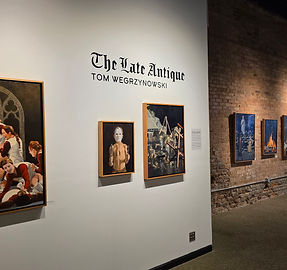
Tom Wegrzynowski (2026)
Tom Wegrzynowski has been a professional artist and educator for twenty years. His work has been featured at venues throughout the Southeast and has won numerous awards. Recent exhibitions include ArtFields in Lake City, SC, the LaGrange Southeast Regional at the Lamar Dodd Art Center in LaGrange, GA, the International FL3TCH3R Exhibit at the Reece Museum in Johnson City, TN, and B24: Wiregrass Biennial at the Wiregrass Museum of Art in Dothan, AL. He also recently exhibited Milestone at Lowe Mill in Huntsville, AL, a two-person exhibition with his longtime collaborator and partner, Charlotte Wegrzynowski. Tom is a past recipient of a Joan Mitchell Foundation grant and is a two-time finalist in the No Dead Artist International Juried Exhibition at the Ferrara Showman Gallery in New Orleans. He earned his MFA from the University of Alabama, where he teaches as an Assistant Professor.
My work has long been concerned with the unstable nature of meaning. This stems from how historical and cultural traditions are used as raw material to validate contemporary social, political, or religious power structures. This interpretive process has become more complex since the idea of a shared culture has fragmented into a post-truth world, driven by social media, old-fashioned corruption, and foreign interference in what had been a relatively stable democracy. This reframing of culture and history becomes progressively more absurd as it is used to support more extremist visions of American society as variations of utopia or apocalypse. I have developed my own symbolic language to speak to this process and the power structures such processes inhabit. I use traditional painting methods to render these systems as a remnant of material truth.