.png)
2025 Exhibition Catalog
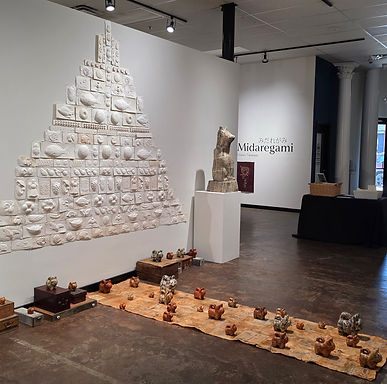


みだれがみ Midaregami
Chiharu Takahashi Roach (2025)
“Chiharu Roach is from Nagoya, Japan, where she received her education degree with an emphasis in child psychology. After moving to Birmingham in 2001 and getting her art degree from the University of Alabama at Birmingham, she began painting her tangled hair series, exploring the spiritual connection between humans and their range of behaviors and emotions. She paints each hairline as a prayer for her clients, the piece’s future owners, and a special friend who is not with her anymore.
Also, Chi often portrays cultural differences and stereotypes between Japan and America based on her experiences living in both countries and expresses her mind without using the sound of speech. Now Chi is challenging herself to use 2D as well as 3D art, and mixed media to express themes of memories, spirituality, loss, and humanity.”
Learn more about the artist here:
Chiharu Takahashi Roach: https://magiccityart.com/artists/chiharu-roach/
@chiroach
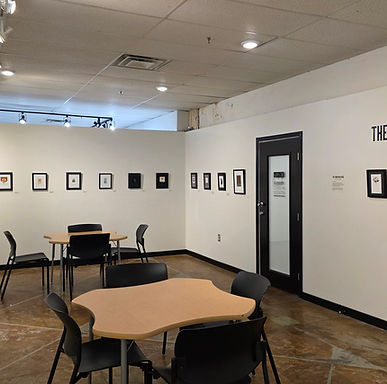


The Christmas Rose
Michael Swann (2025)
"A rose is not just a rose...
Before becoming a visual artist working in a number of mediums, Michael Swann worked as an airbrush artist, painting t-shirts throughout his high school and college years. Each holiday season, his grandmother, Clayton Roberts, would request a rose airbrushed onto a sweatshirt for Christmas.
Later, Swann was inspired to produce a small run of original prints depicting a “Christmas Rose” in honor of his grandmother. That effort blossomed into an annual creation of hand-pulled rose prints."
Learn more about the artist here:
Michael Swann: https://www.michaelswann.net/
@michaelswann


Transfiguration: The Fourteen Black Paintings & Other Selected Works
Celeste Laborde (2025)
"Celeste Laborde (b. Birmingham, AL, 1977) has been painting ever since she was old enough to hold a paintbrush, and with the exception of a few short periods when she was enamored with rocks, fossils, and marine life, and dream of pursuing science as a career, she has always been focused on the visual arts. She nurtured her love for painting and photography in high school, going on to receive a BFA degree with a concentration in both mediums from the University of Montevallo in 2004.
While taking a modern dance class at the University of Montevallo (to fulfill a physical education requirement), she unexpectedly fell in love with dance. Modern dance was exciting, and fully embodying storytelling and emotion with physical expression was exhilarating. It was during this time that she was introduced to Butoh (a Japanese dance theater style which emerged immediately following World War II) and everything changed. She has been performing Butoh and improvisational modern dance ever since.
Butoh was a perfect fit for her personal aesthetic and proclivity for the avant-garde. Completely engrossed with black and white photography at the time, Butoh simply looked and felt like the photographs that she wanted to capture. A few years into her studies, quite possibly spurred by the physicality of dance, Laborde started to focus on more tactile ways of exploring photography and became increasingly interested in the physical act of making large-scale paintings and drawings.
After giving up the darkroom, the love and influence of black and white photography are undeniably still evident in the rich ink-based paintings she creates today.
Laborde’s art practice is intrinsically intertwined with her physical practice. Her paintings and performances are extensions of each other. She takes cues from dance to create paintings that explore the perception of time and intercorporeal communication, and celebrate physical, emotional, and spiritual movement.
As a student of the New York Butoh Institute, she studies regularly under the Institute’s founder, Vangeline, and has also had the honor of studying and performing with Sankai Juku dancer, Akihito Ichihara. Laborde is also a long-time Ashtanga Yoga practitioner and casual runner who lives, works, and performs regularly in New York City."
https://www.celestelaborde.com/


N513AJ
Autumn Baugh (2025)
Autumn Baugh is a visual artist from Gadsden, Alabama, whose practice engages the intersection of fine art and industrial design, reimagining mechanical components as aesthetic and conceptual objects. She studied at Jacksonville State University, where she earned a Bachelor of Fine Arts in 2022, and at Gadsden State Community College, where she received an Associate of Art in 2018.
Her artistic foundation spans drawing, painting, and sculpture, disciplines she has pursued since childhood. Over time, her practice expanded into explorations of engineering and fabrication. During her undergraduate studies, she engineered, fabricated, and wired a 48-inch remote-controlled car, a project that marked the genesis of her ongoing engagement with industrialization as both subject matter and method. This feat ultimately guided her into the aviation industry, where she established her professional career as an Aircraft Scheme Designer and cultivated her parallel ambition of becoming a pilot.
Her current work examines aviation not through its grand forms, but through its smallest and often overlooked elements: screws, wires, panels, and fragments that once served purely functional roles. Through processes of collection, transformation, and recontextualization, Baugh positions these remnants as sculptural artifacts that speak to memory, time, and the human pursuit of flight and glory.
https://evokeaircraftdesign.com/


Nature: Stitched and Sutured
Michelle Reynolds (2025)
"Creating ecology-inspired pieces from recycled fabrics and telling stories through my art, I strive to weave together lessons in sustainability and appreciation for the natural world. Reality meets mythological and biblical in my work. Snakes are woven into the themes as symbols of health, regeneration, and renewal. Slithering through the scene, they become beacons of hope as I ponder the problems and perils of the world.
Pieced, patched, stitched, and sutured, my art symbolizes the reverence I have for the interconnections in nature and the fragility of habitats and food webs. Retreating into the garden and finding nature vignettes everywhere I turn, I often ponder the complexities of relationships — between creatures and habitats, plants and animals, man and nature. I’m always seeking to understand and find my place and responsibility in the natural world. Even though connections in nature have been forged over long periods of time, the processes are ongoing. Life is fragile. Natural systems and the ties that bind can unravel in moments."
----
Michelle Reynolds, textile artist, nature writer, habitat gardener, native plant enthusiast, and advocate for environmental awareness, lives and works in Birmingham, Alabama. With a passion for Alabama’s rich biodiversity, and through her nature-inspired art and ecology-based writing, programs, and community garden projects, she hopes to bring to the public an understanding of the natural world and attention to ecological issues.

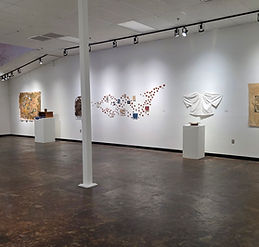

Entangled Time: Entangled Space
Nell Gottlieb (2025)
"Entangled Time: Entangled Space reflects the Indigenous understanding of time as cyclical, layered, and connected with space. This contrasts with Western or “settler” time, which is linear, focused on progress. For settlers, progress meant “civilizing” Indigenous people to European ways, making the land more productive, transforming “empty” land into surveyed and deeded property, and harnessing the power of the rivers. For the Muscogee, the land and rivers were communal and sacred. Settler definitions of “civilization” dismissed existing fields, traditions, and governance. These tensions came to a head in the 19th century in Alabama.
The Coosa and Tallapoosa Rivers were once the hunting grounds and homelands of the Muscogee people. On the Tallapoosa, the 1814 Battle of Horseshoe Bend ended in defeat and the Treaty of Fort Jackson ceded 21 million acres to the United States. That land was quickly sold to settlers eager to build cotton wealth through enslaved labor.
These rivers also hold my own history. My grandfather’s family were settlers and enslavers along the Coosa. My grandmother’s line traces back to a Muscogee great grandmother at Tuckabatchee on the Tallapoosa. This elder’s strength and connection to the land was transmitted to me by my grandmother through word and deed.
These 19th-century patterns persisted into the 20th, and today, with systems reinforcing the inequities of slavery, racism, and cultural erasure and the economies of cotton and timber. Rivers were dammed to create hydroelectric power, flooding towns and cemeteries and pushing species toward extinction. The settler vision of time, progress, and industry achieved dominance.
This exhibition gathers fragments of those histories. Works in multiple media explore the rivers as carriers of memory, conflict, and continuity. Landscapes, river dirt, written meanders, and stitched flowing water and survey grids ground the work.
Though divided by a gallery wall, the Coosa and Tallapoosa share one story—entangled in time and space."
-----
"Nell Gottlieb works in multiple media to reexamine her coming of age, white and female, in the Jim Crow South, as well as her family legacy, which includes both enslaver and Muskogee ancestry. Her work considers settler colonialism, enslavement, and Indigenous removal, along with their continuing effects of inequality, racism, ecological degradation, and cultural erasure. Gottlieb completed the Block Program of the Glassell School of Art at The Museum of Fine Arts, Houston (2019). In 2018, she co-founded the Wallace Center for Arts and Reconciliation, a non-profit organization that promotes reconciliation, healing, and repair through arts, education and cultural programming. She has had solo exhibitions at the Gadsden Museum of Art, Gadsden, AL (2025), the Montgomery Museum of Fine Arts (2022), the Neill-Cochran House Museum in Austin, TX (2022), and the Community Artists’ Collective in Houston (2020). She holds a BA and MA (psychology) from Emory University and a PhD (sociology) from Boston University. She is a professor emeritus of public health education at The University of Texas at Austin, where she taught from 1980 to 2011. A native of Alabama, she has lived in Texas since 1980."
www.nellgottlieb.com
www.wallacearts.org


The Nomadic Lens
Greg Light (2025)
Local photographer, Greg Light, uses the camera to explore the different landscapes across the United States and Canada. Light is retired from the City of Gadsden Police Department and has enveloped himself in his hobby of photography.
https://www.thenomadiclens.net/nature


The Hidden Order of Grief and Hope
Kariann Fuqua (2025)
"We are at a crossroads where we must choose how to live responsibly on a planet in crisis. The rapid pace of environmental destruction from human activity and the accelerating pace of climate change require a paradigm shift. My work reflects a philosophical reordering, an interconnected way of being in the natural world.
From drawing to installation, I cultivate an appreciation for and a greater understanding of the ecosystems we inhabit. Through abstraction, my work rests in the liminal space between order and chaos, using space as a metaphor for loss, longing, and uncertainty. Expressive mark-making becomes a meditative practice, evoking a sensory experience or a force of energy. I use edges and boundaries as important signifiers of the false hierarchy between the human-centric world we try desperately to control and the biological one we are evolutionarily a part of.
I use my garden and the surrounding neighborhood as a laboratory, closely observing the cycles of ecological systems. Each location is a unique micro-climate, with individual characteristics and needs to thrive. Collecting, preserving, and documenting species and phenomena in these spaces becomes both source material for the work and a call to action for the radical care necessary for our collective survival. I incorporate natural materials – roots, inks made with plant material, and seeds – alongside more traditional media, creating a more sustainable practice.
As the pendulum swings between grief and hope, I want to raise awareness of our mutually dependent relationship with the land and all that dwells within, challenging others to become better stewards of a livable future. Time is of the essence."
- Kariann Fuqua


Roots Run Deep
Leigh Ann Edmonds (2025)
Alabama documentary photographer, Leigh Ann Edmonds, focuses on everyday life with an underlying emphasis on human connection. Her work is often described as timeless, gritty, and soulful.
Leigh Ann studied photography and journalism and obtained a BA in studio art from the University of Alabama, Tuscaloosa. Her work continues to focus on the use of classic black and white 35mm film, as she feels it helps to create nostalgic and enduring storytelling images.
Edmonds has most recently been featured in All About Photo, Black and White Magazine, Street Photography Magazine, the Pictorial List, Monovisions Magazine, and Birmingham City Lifestyle, along with podcast interviews with Street Photography Magazine and Street Photography Mentor.
"Leigh Ann has an unending passion for the craft and a deep connection to the people and places she photographs." – Melanie Meggs; The Pictorial List.


Speculative Geography
Caroline Hatfield (2025)
"Through sculpture, installation, and images, I explore our perception of landscape as medium and nature as commodity. Observing land use and extractive practices in southern Appalachia has shaped my work to be very materially driven, often sourcing specific objects or waste for their conceptual relevance. This influence converges with my interest in science fiction, which deeply informs my creative process as I consider sci-fi tropes, frameworks, and extrapolations. By juxtaposing moon rocks, Martian terrain, coal waste, driftwood, and geological samples, I create speculative forms that build upon our language of observation, taxonomies, and exploration.
Two directions of interest have emerged in my recent projects. One focuses on materials and concepts associated with near-future climate engineering and celestial resource extraction. The other engages with com-modified or altered examples of “nature” (such as parks, artificial lakes, and preserves) while drawing inspiration from current scientific research that reveals the agency and intelligence of the more-than-human world. In both cases, I consider our past, present, and future relationship to the environment, while questioning the limits of human understanding, consumption, and intervention."
- Caroline Hatfield

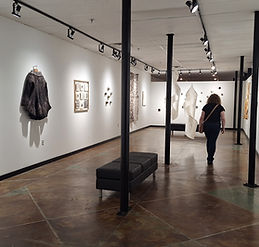

The Wind Knows Why
Kami Watson (2025)
Kami Watson (b. 1972, she/her) is a second-generation fiber and textile artist based in Huntsville, Alabama. Specializing in wet felting, a centuries-old process, her work combines renewable fibers, reclaimed textiles, and hand-dyed materials to create sculptural and flat works that blend personal narrative, connection to craft, sustainability, and storytelling.
She is an Alabama State Council on the Arts Individual Craft Fellowship recipient, and has been accepted into numerous regional and national fine craft guilds. Her work has been shown in solo and selected group exhibitions, she has participated in juried art and fine craft shows throughout the south and east coast, and her pieces have been in retail galleries nationally.
A Returned Peace Corps Volunteer and former AmeriCorps VISTA, Kami brings that same passion for outreach and education into her creative practice. She has received multiple grants, including from The Verdant Fund, and is an experienced teaching artist, having led workshops at the John C. Campbell Folk School, Huntsville Museum of Art, Kennedy-Douglas Center for the Arts, Lowe Mill ARTS & Entertainment, and the North Huntsville Public Library. She is also an active member of the Alabama Women’s Caucus for Art.


Feathered Focused: Wild Birds Through the Lens of David M. Frings
David Frings (2025)
"I have been a photographer since middle school when my father gave me a Petri SLR camera for Christmas. At the time, I primarily wanted the camera so that I could document the behavior of the numerous tropical fish species that I kept. A family friend helped me navigate the camera settings and instructed me on the methods of photographing through glass and water. Since I already had a great appreciation and love for nature, I was on my way to capturing images of my fish that I could later share with others. At this early age, my camera was simply a tool to complete a task. I did not see it as a tool that could be used to create art or inspire others.
As the years passed, I began to branch out in photography by focusing on many of the typical subjects, such as family, friends, events, and vacations. During these years, I still viewed my camera as a complex tool and not an artist’s brush. My love for nature began to blossom, so my interest in photography shifted to nature. I have always loved flowers and wildlife, ranging from butterflies to reptiles to birds. For me to be successful capturing quality images of live animals, I quickly learned that I had to improve my knowledge of their habits and the correct camera settings. I was no longer satisfied with capturing the image of a static bird on a feeder or a wire. I wanted expressions and moments such as feeding, bathing, nesting, or conflicts. Capturing the action through imagery raised the bar on the skills required to do so but allowed me to tell a more complete story of my subject.
As I grew and developed my photographic artistic style, I reviewed the work of renowned photographers like Art Wolfe, Frans Lanting, and Thomas Mangelsen for inspiration. I sought out instructional videos and in-person training that not only improved my skills but taught me a variety of new photography techniques. I found that the continuing education not only allowed me to learn new techniques, but it also gave me the opportunity to include new subject matter in my professional portfolio. Even though I have added a diversity of new subjects to photograph, I still want each photograph to supply the viewer with as much information about the moment as possible. I do this by evaluating the scene before I actuate the shutter. By taking a step back to evaluate the scene, it allows me to insert a level of artistic expression that draws the viewer into the moment that I capture in my images.
My goal is to use the photography skills that I have gained over the years to tell the stories of the subject, whether that is through a single photograph or a series. As I have grown, I recognized each photograph as a piece of art that can be used to raise awareness and enlighten those around us. I want my work to inspire others by allowing them to experience the beauty of the world around us and foster the desire to protect and preserve that beauty."


On Divers Arts: A Tribute to Theophilus
Linda and Charlie Munoz (2025)
"Most of my sculptures are concerned with the human figure. I usually work directly in wax and then cast the pieces in bronze, aluminum, or iron. I almost never have a 'plan'. A limb, or head, or foot will emerge and gradually become a human figure. Frequently, wings or horns may appear.
One of my most treasured artistic experiences has been my years of teaching the Suzuki Strings music programs. I also enjoyed teaching jewelry classes to adults and children at the Meridian Museum of Art."
- Charlie
"Vibrant patterns, textures, and colors are vital elements in my glass artwork. Coming
from a family in which quilting was a much-loved and practiced art form, I enjoy
creating mosaic and fused glass art pieces inspired by the lines, shapes, and colors of
the quilts I grew up with as a child. Working with community arts groups is one of my greatest pleasures.
Many of my large mosaic works have broken china, pottery, or other precious mementos from disasters such as the tornadoes of 2011 that ravaged Tuscaloosa, Alabama. It is my hope that beauty and healing can come from destruction and despair."
- Linda


On the Grid/Off the Grid
Amy Feger (2025)
The paintings in One the Grid/Off the Grid arise from my awareness of living in the liminal space of “The Information Age” and “The Anthropocene.” Collectively, the artworks express the paradoxes of meaning relating to our present simultaneous realities. Living off the grid was once associated with hippies and the back to the earth movement of the 1970’s: people moved to a rural place, lived off the land, and sustained their existence in balance with nature, rejecting the corporate industrial systems supporting a capitalist economy. Since the 1980’s, living off the grid has become associated with far-right extremists who move to rural places as a rejection of government control and democratic social systems. For both counter-culture ideologies, to live off the grid is to critique the system, to provide an alternate way of living, and to change the system from the outside.
The structure of the grid informs all man-made systems: Cartesian grids, power grids, fiber-optic networks, vector graphics, urban grids of public streets and roads. To be on the grid is to have a position within the system, to be connected in a network, to be complicit in the system, to be an observer of the accessible aspects of the system from within.
Since 2013, I have been exploring inaccessible mining and power production sites using Google Earth to explore hidden landscapes virtually. These digital excursions provide source images for this ongoing and ever-evolving series of metaphorical landscape paintings that reveal the layered histories of the toxic relationships between industry, development, society, and local ecologies.
During one early “virtual hiking” mishap, I discovered it was possible to penetrate the thin layer of data that renders the digital landscape. By hacking the terra incognita of inaccessible, geologically rich mines and quarry landscapes in Google Earth’s 3D map renderings, these paintings offer perspectives that are both behind and within the scene. By collaging figures into an otherworldly and phenomenological landscape, I visualize an explosive energy of fracture, the skeletal grid of virtual reality in a state of collapse.
My fascination with maps as representations of the landscape led me to Jorge Borges’ parable, “On Exactitude in Science,” a chronicle of the creation of a 1:1 map of the world that became a separate and distinct reality. The story prompted me to recontextualize the internet, Google Earth in particular. Current technologies, including artificial intelligence and efforts to colonize Mars, manifest humankind’s excessive drive to advance knowledge, achieve power, gain wealth, and construct irrational and self-serving real and virtual monuments that attest to the merciless human indifference of these pursuits. The real world is being marginalized and treated inhumanely because reality, like Borges’ map, is “Unconscionable,” unwieldy, obsolete, and out of fashion.
Creating these paintings qualms my personal fears that hyper-real virtual representations found on the World Wide Web are uncanny and misinform humankind.
My paintings present a framework through which the complexity of hyper-objects can be understood. Because no single hyper-object can be represented, the artworks are catalysts for considering how to live in the time of hyper-objects. Each painting is a discourse on the imperfect and mediated reality as granted by technology. Ultimately, they raise questions about the real landscapes of our future.


Architecture of Release
Heather Baumbach (2025)
Heather Baumbach’s work is inspired by her community, her travels, and the beauty of everyday life. She enjoys working with her hands, creating works notable for their deft finish and tactile nature. Her visual art has been exhibited at MASSmoca, The Broad Institute of MIT and Harvard, The Wiregrass Museum of Art, The Georgine Clark Alabama Artists Gallery, Lowe Mill Arts, and The Charles W. and Norma C. Carroll Gallery at Marshall University. She also holds over 30 years of design and production experience in stage, television, and film, her credits including The Cherry Lane Theatre, The Theater Outlet, The Santa Fe Opera, The Los Angeles Opera, Maine State Music Theatre, Center Theatre Group, Carsey-Warner Productions and Comedy Central. Heather holds a BFA in Costume Design from UNCSA and an MFA in Visual Art from Lesley University. She is currently an adjunct professor in both the Art and Theater departments at The University of Alabama, Huntsville.


Disparities
Celestia Morgan (2025)
Disparities closely examine the everyday structures and unique challenges faced by marginalized communities. It builds on themes from a previous series called "REDLINE," which explored how racial zoning and housing discrimination have impacted these neighborhoods, including local grocery stores, restaurants, and polluted environments.
Each location tells a visual story, rich in meaning and layered with metaphors that reflect personal experiences. This work goes beyond the photographic lens, drawing inspiration from maps, minimalist art, painting, and sculpture. I intentionally incorporate recognizable elements, carefully considering their arrangement and utilizing color theory, light, space, and physical proximity. I aim to enhance the aesthetic quality while referencing the historical nature of discriminatory practices in our communities. This approach leads me to consider questions such as: What visual cues help us understand community spaces, and what might the future look like for these areas?


Whispers in Oil
Mary Moore (2025)
Mary Moore’s journey began with an appreciation for the beauty found in nature and history. Over the years, this grew into a hands-on passion, leading her to explore the rich textures and depth that oil paint offers. She also finds inspiration through the media and in the delicate details of florals, the serenity of landscapes, and stories of historical subjects. Mary occasionally ventures into portraiture through expressive brushwork. She strives to blend observation with emotion, inviting viewers into a world that feels both timeless and personal.


2 Cool 2 B 4gotten
Jennifer Wallace Fields (2025)
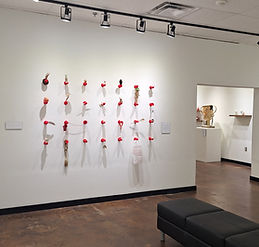
Jennifer Wallace Fields’ artistic practice is a process of emotional archaeology: digging through internal remnants and external artifacts that might be reassembled into narrative, myth, or quiet confrontation.
While working primarily in clay, Fields increasingly incorporates found and mass-produced objects—thrift store souvenirs, discarded trinkets, synthetic charms—alongside natural materials. These elements reflect her deepening interest in the human experience as a fractured and often commercialized one. In recent works, memory becomes something not only passed down or forgotten, but suspiciously misremembered, iconized, or re-invented altogether.
Her ongoing body of work, including the exhibition 2 cool 2 B 4gotten, reflects a familiar use of text, humor, and surreal assemblage to navigate questions of identity, impermanence, and the absurdity of modern ritual. Teacups become emotional portraits. Ceramic hands hold fragments of unsolicited language. Horses, trophies, and party cups act as stand-ins for moments of disillusionment, transition, and resilience.
Through the physical and metaphorical shapes of women’s lives, Fields continues to examine the pressures and dualities of gender, sexuality, and cultural expectation—both inherited and self-imposed. Her work remains rooted in the primal, spiritual, and emotional intersections between nature and society, even as it increasingly embraces the artifacts of a disposable, digitized world.
Across it all, Fields is interested in the thresholds—between humor and heartbreak, beauty and banality, permanence and erasure—and the objects we carry across them.


Today’s Sale Color
Bethany Moody (2025)
Bethany Moody:
My practice grapples with the superabundance of material culture by reclaiming and retooling discarded textiles from local thrift stores, junk shops, and friends’ homes. Through secondhand sourcing and labored processing, I consider the connections among the waste we create, the environments we inhabit, and the communities we build. Single-use plastics, coarse acrylic yarns, threadbare sheets, and vibrant poly-blend fabrics foreground my work. These materials, disposed of as quickly as they were produced, are juxtaposed with more precious and durable wood, wool, and cotton fibers. Some surfaces are activated with fast, ad hoc painting and drawing (airbrush, marker, ink) to contrast the deliberate craft-driven processing.
With care, I dye, knit, crochet, weave, sew, fuse, stuff, and assemble these diverse materials into sculptures, two-dimensional works, and installations. The built environment and the body influence my work, with a focus on overlooked objects like bricks, doors, pillows, and looms. In multiples, these forms assemble into familiar structural arrangements that speak to transition, support, and rest. Sensory items such as plush toys and knit apparel also inform my work, both in their technical construction and their intimate relationship with the body.
Across dimensional formats, haptic elements are cultivated to bridge the gap between the viewer and the object. At times, commonplace stuff in dynamic combinations can engender closeness: a slick yet striated fused plastic bag next to a gnarled single crochet fabric invites the viewer to touch with their eyes. Some pieces are explicitly interactive—to be probed, tugged, hugged, kneaded, and pet by the viewer. This results in gestures between the viewer and objects that can be erotic, humorous or satisfying. Occasionally, viewers become participants, contributing to the work through somatic engagement—tucking written messages into secret spots, spreading across a plush raft in repose, dyeing salvaged sheets, or weaving on a jumbo loom. Through haptic activation, the physical connection cultivated between the artist and artwork is, in part, shared with the viewer.


A Homily for the Pink Moon
Anne Herbert & Wade MacDonald (2025)
Anne Herbert:
My painting process is an act of searching and experimentation. It is also an operation of loss and discovery. Paying close attention to the unique occurrences, I work in a reactive way that allows each painting to develop along its own path. This is inherently disobedient; each mark is a point of negotiation. As marks build, so does the tension between shapes and colors, surface and depth, and clarity and obscurity. The resultant paintings embrace uncertainty and the unknown—the feeling of being both present and elusive in the world, often unsure of what’s behind the curtain, but compelled to keep searching.
The pace at which I work allows the paintings to bear witness to the day-to-day. My experiences, environment, and emotions emerge as form, figure, and color. It is a constant act of tuning into the present moment, with all of its imperfections, messiness, and contradictions. Making a painting, for me, means coming face-to-face with the imperfection of my marks, gestures, and choices. In this act of self-acceptance, I locate myself, and it is humbling. Such gestures—sustained over time—ground me within the cycles of my life. They become the visual manifestation of my connection to the world, to my own experiences, and to the recurrent experience of being.
Wade MacDonald:
Contemporary architectural design and construction represent a remarkable fusion of artistic expression and practical functionality, akin to a form of innovative utilitarian sculpture. By examining the shared stylistic elements, production methods, and utilitarian goals of contemporary architecture, artists and designers can identify and address the societal challenges they present.
The intersection of ceramics and architecture is a dynamic and symbiotic relationship. Both disciplines address social concerns through their aesthetics and utilitarian nature. By highlighting this connection through the reinterpretation of the pedestal and the incorporation of diverse construction materials alongside clay elements, contemporary architecture gains a more relatable human quality. As architectural models, my work serves as a means for viewers to gain insights into their individual roles within the broader social fabric. Clay acts as a conduit, bridging past and present ideas of material innovation, challenging our notions of new architectural paradigms, and questioning the relevance of ceramic art forms in the twenty-first century.
Through extensive research, ideation, and practical application, I have laid the foundation for celebrating the human element of contemporary architecture and the clay object, recognizing their shared essence as fundamental concepts or structures. I firmly believe that this intrinsic correlation possesses the conceptual power to reflect the intricate complexities of living in a globally fragmented community.


True Colors
True Colors - Etowah County Board of Education (2025)
True Colors brought an exhibition that featured student artwork from Sardis High School, Whitesboro, West End Elementary, and West End High School at the Gadsden Museum of Art. The exhibit was on display in May 2025.


You Are What You Eat
Stacy Tabb (2025)
The "You Are What You Eat Series" is comprised of multiple species of creatures, each depicted containing their primary food source in place of their scales, feathers, shells, and fur. They were drawn using pencil on paper, then transferred to carving blocks via carbon paper. Each was carved and detailed using sharp woodcarving gouges, then inked and printed on fine, archival watercolor paper using professional oil-based relief ink. Select prints were then highlighted using watercolor paints.
The series is very much inspired by Scandinavian and Pacific Northwest styles of folk art, where all negative space is filled, and perspective is very subjective. Geometric shapes take the place of shadows and highlights, and key elements, such as the lightning bolts and mayflies, are echoed throughout the series. Later pieces contain elements that pay homage to the indigenous cultures that share space with the animals' native habitats.


GMA Children's Show
GMA Children's Show (2025)


Analog and Digital Work
Terry Muirheid (2025)
Terry Muirheid was born in Miami, Florida, on May 18, 1949. He lived in nearby Coral Gables, Florida, where he attended elementary school, junior high and high school. He graduated from Georgia Institute of Technology with a Bachelor of Science Degree, in Architecture in 1972, and worked on a Masters Degree in Fine Arts at Georgia State University during 1972 and 1973. He had several one-man art shows at Georgia Tech in the 1970s. He also designed several murals for public buildings.
As a registered architect in Georgia for over 50 years, Terry has worked primarily on residential projects, new homes and remodeling.
Terry has been active as an artist over the years, painting and drawing. Digital photography became a primary interest of his starting in 2003, while he pursued extensive work in Adobe Photoshop.
Terry had prepared art print calendars in the late 1970s, and in 2011, started yearly calendar prints with digital photography and Photoshop. Since 2011, he has designed up to 8 yearly versions of the calendars (a total of over 80 calendar designs) which he sends to architectural clients and friends.
Since 2020, he spends a majority of his working hours on digital art using Adobe Photoshop and Adobe Fresco and on the more traditional art forms of drawing and painting.


Atmosphere: From The Blue Marble
Sonja Rieger (2025)
“ In my country in August there’s a peculiar quality to light ...”
William Faulkner
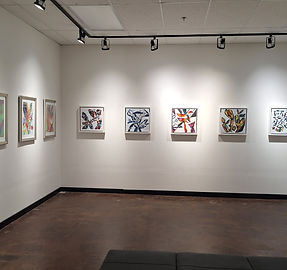
In 1972, a member of the crew of the Apollo 17 spacecraft took a photograph of the Earth on the way to the moon. To the astronauts, Earth appeared as a small blue marble. It was fully illuminated, and the resulting photograph was the first clear image of our world as seen from deep outer space. Stewart Brand, American writer and editor, spent years campaigning for just such a photograph. He was convinced a picture of the entire planet would change how humans related to it. Many would see this photograph and realize the Earth was more than a school room globe, and it forever changed their perception of the Earth. The photographs in this series are colored by this photograph and the view from the other side, as if they were taken from the blue marble.
The twelve photographs on the right wall are a subset of the series called Homage to the Sky. These twelve images employ Josef Albers’ formula of concentric squares, which he used in his vast exploration of color theory, Homage to the Square. Albers worked on this project using squares of pure color for twenty-six years. In Homage to the Sky, Albers’ format of three concentric squares of color is replaced by three concentric squares of images of the sky. In some cases, the sky looks like pure color, and in others like pure space. At times the clouds shimmer and turn silvery. In those with an ethereal sense of space and a shift in perception, recognition must go to artists such as Robert Irwin, who worked in the field of spatial perception for many years. But all in all, the images redefine and pay homage to the sky.
Every August, I find myself enthralled by the light and immense rolling clouds in the Southern skies. Atmosphere is a series of photographs of that sky using multiple images to explore light, space, color, and atmospheric qualities.
www.sonjariegerphotography.com


Common Bonds: Observations on the Human Experience
Erin Hardin (2025)
Unlike many artists, I didn’t grow up drawing constantly. I didn’t carry around a sketchbook or watch hours of Bob Ross on end. I played. I daydreamed and pretended. I stared at caterpillars and tree bark, and I grew up listening to older generations tell story after fantastical story.
Most people have moments they can point to in their lives in which something subtle shifts, and they suddenly see the world from a different angle. Often, these profound moments mean little to the people around them. For me, two of those instances converged.
The first was when, as a small child sitting in the back seat of the car in rush hour traffic, I had the startling (though now, of course, obvious) realization that all of the cars around me were full of people and that each of those people had their own separate lives. Lives that I knew absolutely nothing about. They had their own pasts, their own stories in which they were the main character. Furthermore, they were going home to people who also had stories of their own stretching out in other directions, connecting with other people. I could almost see the tangled, complicated web of intersecting lives.
The second wasn’t one instance. Instead, it was the same realization over and over again in museums, in galleries, and in people’s homes, in which, looking closely, closely, closely at a painting, I realized, “A person painted this. A human being. A normal person.” These moments are profound because I think growing up, I saw artists as some separate life form. I mistakenly thought that an artist is something one IS, not a profession made up of a set of skills one can learn.
It sounds strange, I know, but I paint so that I can see. What started out as a hobby picked up for the sheer enjoyment of colors on a blank canvas has turned over the years into a fascination with finding ways to depict textures, skin tones, emotions, and even abstract ideas. The more deeply I examine and paint the world around me, the more interesting the world around me becomes, and the more I paint people, the more connected and fascinating we, as humans, seem to be. So, I paint to see, to understand, and to try to convey things as I see them and as I understand them.
www.erinhardinart.com


The Lord of the Sheep
William Canty (2025)
William Canty is a mixed medium/multimedia artist. His art focuses on slavery, specifically religious bondage, and economic slavery. In 1994, he graduated with honors from the Alabama School of Fine Arts as a Visual Arts major. He studied painting and printmaking at the Atlanta College of Art for three years and left to pursue his professional art career. In 2002, he returned to school to study web design and development at Virginia College in Birmingham, where he received his degree.
In 2007, William returned to college to complete his BA in visual art. His original art has been exhibited and collected throughout the Southeast. Currently, William owns and operates three LLCs; a fine art studio called WE-C International Studios, LLC., a graphic/web design called World Wide Digital LLC., and an artist consulting and management firm called Zero Degrees Media LLC.


Beyond the Blazes: The Trail Revisited
Doug Clark (2025)
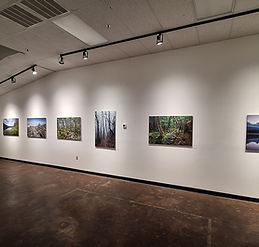
In March of 1994, I started a six-month 2150-mile trek from Georgia to Maine on the Appalachian Trail that would change my approach to the world for the rest of my life. The Appalachian Trail is more than just a path; it is a living, breathing entity shaped by changing seasons, shifting light, and the unique ecosystems along its journey. In 2024, I had the opportunity to revisit the trail with my camera and thirty years of hindsight, and in these photographs, I hope to reveal some of the essence of the trail and its personality, capturing not only its physical beauty but also its emotional resonance.
Thirty years ago, the Appalachian Trail was just a line on a map to me—something intriguing but distant. However, once I stepped onto it and felt the ground beneath my feet, it became much more than that. It turned into a teacher, a friend, and a personal philosophy. At first, the trail was a tough challenge. I wanted to prove myself by overcoming the mountains and pushing through exhaustion. Every mile felt like a small win, and every peak was a triumph. But the trail humbled me; it didn't care about my ambitions. It moved at its own pace, teaching me patience. I learned that the goal wasn't to conquer the trail but to walk with it and be part of it.
As the years passed, that awareness grew deeper. Life took me away from the Appalachian Mountains, but the values of the trail stayed with me. The experience helped me handle stress, reminding me to breathe and take things one step at a time. I found myself appreciating the everyday joys, from the chill of the morning air to the refreshing smell of nature after rain, and the bonding that happens when we share stories. The lessons from those early days became a reliable guide when life felt uncertain.
Now, after thirty years, I see the trail differently, like a mirror reflecting my changes. I recognize the same rocks and trees, but my perspective has shifted. Instead of trying to prove myself, I feel grateful for the strength I had in my youth and the wisdom I've gained since. The mountains are still challenging, but they now feel like gifts rather than tests. The trees I once walked under are now taller, and the stones I sat on are smoother, weathering countless rains. Yet, the trail seems timeless, reminding me how fleeting life is compared to something so enduring.
At the beginning of my hike in 1994, I realized that the Appalachian Trail was more than a place to visit, and I knew that it would become a part of me. However, I don’t know if I appreciated the depth at which it would infuse my choices. Upon reflection, it has been a mantra - a steady rhythm echoing through my life, marking important moments that shaped who I am. It is not just a path through the wilderness; it’s a connection to the significant lessons of my life, grounding me to the earth, myself, and something larger than I can describe.
- Doug Clark