.png)


Chasing Ghosts, Capturing the Spirit
Zipporah Camille Thompson (2024)
ABOUT THE ARTIST
Zipporah Camille Thompson (she/her/hers) is a weaver and sculptor based in Atlanta, Georgia.
Thompson’s work explores alchemical transformations through clay and woven textiles, delving
into themes of chaos, metamorphosis, and triumph. Her practice weaves together ancestral
narratives with Black and Brown liberatory histories, alongside imagined geographies, creating
altars, sculpted shapeshifters, and hybrid landscapes. Through these works, she investigates
hope, myth, magic, and the reclamation of power within a boundless spiritual framework.
Thompson earned her MFA from the University of Georgia and her BFA from the University of
North Carolina at Charlotte. Her work has been featured in numerous publications and exhibited
nationally and internationally. She is a 2024 Skowhegan resident, a 2024 South Arts Georgia
Fellow for Visual Arts, a 2023 recipient of the Margie E. West Prize, a 2021 MOCA GA Working Artist Project Fellow, a 2020 Artadia Atlanta Awardee, and has received multiple honors, including the Watershed Zenobia Scholarship, the NCECA Multicultural Fellowship, and an Idea Capital Travel Grant.
Thompson is represented by Whitespace Gallery in Atlanta, GA. Outside of her practice, she is a
history enthusiast, roller-skater, and lover of unicorns, zombies, the moon, tarot, and all things fantasy.
ARTIST STATEMENT
My work is rooted in ancestral traditions, where I use clay and fiber to hand-weave nets, baskets, and tapestries. Through these materials and processes, I explore light, shadow, chance, and the magic that exists in the spaces between. Drawing on mythology and the otherworldly, I overlay these works with the haunting ethereal qualities of landscape paintings influenced by manifest destiny. Using neon hues and iridescent material, I channel healing energy and protection magic for Black/Indigenous, cis/nonbinary/trans, differently-abled, women, and femmes—past, present, and future.
Inspired by Southern Gothic and occult traditions, I move beyond rigid, traditional
thinking to connect with source energy and a limitless spirituality centered in queerness, empowerment, and choice. Through abstraction, ecology, and the fantastical, my work conveys a mystical, alchemical message that reflects fluidity, chaos, metamorphosis, and cyclicality.
Drawing on natural forces—oceanic currents, resilient marsh habitats, hurricane gusts,
the ouroboros, celestial bodies, cloud formations, moths, weather patterns, and auric fields—my work embodies a divine power: the power to recreate, redefine, and protect oneself in a rapidly changing climate. This message speaks to the futurity and possibility of our collective resilience in the face of vulnerable, increasingly unrecognizable landscapes.
At the heart of my practice is lunar feminist power, a gentle reminder that we can summon
triumph, hope, and joy even during the darkest nights. The work calls us to pause and recognize that the strength and healing we seek has always been within us, deeply rooted in the land—nourished by matriarchal soil workers, washerwomen, fishers, and caretakers of home, family, and the natural world.

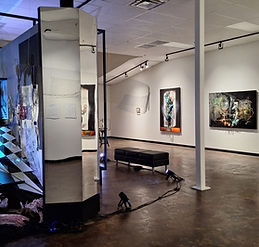

Patterns In Time: Becoming.. Being.. Disappearing
Patricia Boinest Potter & Jesse W. Akers (2024)
ABOUT THE ARTISTS
Patricia Boinest Potter
Patricia Boinest Potter was born in Charleston, SC in 1940 and currently resides in Anniston, Alabama. She completed her Bachelor’s degree at the Atlanta College of Art, now Savannah College of Art and Design, and received a Master’s of European Studies in Architecture, MESA, a nomadic program: London, Paris and Helsinki. Her father was an Architect, as is her daughter, so the built environment has been a through-line in the artist’s life. Potter has been a Visiting Professor of Architecture at Auburn University, Iowa State University, and Jacksonville State University. Her works have been included in numerous solo and group exhibitions around the world, including Paris, France; New York City, New York; Richmond, Virginia; Santa Fe, New Mexico; Newton, Massachusetts; and New Orleans, Louisiana.
Jesse W. Akers
Alabama native Jesse W. Akers, b. 1995, has been collaborating with Pat Potter since 2018. Not only does the autodidact artist assist in manifesting her vision physically, he has grown into the role of full collaborator and project manager. Through his life’s work, Jesse has been influenced by nature, architecture, and fashion exploring themes of existence. He is a multi-media artist that has been guided under the tutelage of Potter and other artists at artXarchitecture studio. He refers to what they do together as a shared intellectual endeavor. “Though technical and strategical experiments have led to new skill sets, new methods of seeing have been the most profound and seem to be a consistent vision for the studio and imaginatively persistent to the process.”

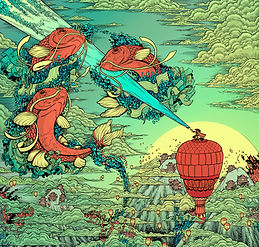

Illustrations by Taylor C Adams
Taylor C Adams (2024)
TAYLOR C ADAMS:
I enjoy making my art with detailed line work, bright saturated colors, and exploring how beings could exist in a fantasy world all while getting lost in that world myself. I’m heavily inspired by Franco-Belgian comic artists, Japanese Manga, and gig posters from the 60's and 70's.
ARTIST STATEMENT
When I'm not on a tight deadline, I love taking my time with the process: sketching on bristol paper, inking with rapidograph or isograph pens, scanning each section in, and then stitching it all together on the computer. I typically color my work digitally through programs like Photoshop or Procreate. I’m very accustomed to working with screen printers so I create with color separations in mind and tailor my palettes to the silkscreen process.


Dinner with Friends
Courtlyn Collins (2024)
“Dinner With Friends,” Courtlyn Collins
Artist Bio
Courtlyn Collins is a 27-year-old creative rooted in Glencoe, Alabama. The youngest of four siblings, Collins inherited her passion for photography from her sister Shea, who often considered Collins her muse. For Collins, photography is a subconscious comfort that traces back to her earliest memories, forever linked to a familiar sense of carefree fun characteristic of childhood.
Like her work, which reimagines youthful freedom with a dreamlike haziness, childhood is a distant dream that was once real. Nostalgic pastels, retro set designs, and vintage clothing fuse with inspiration pulled from coming-of-age films, music, and literature to create Collins’ recognizable style. Photography grants Collins creative exploration to delve into color and texture, testing new methods to combat the mundane and capture the whimsy hidden in everyday routine.
Whether Collins is thrifting a 1980’s dress for a photo shoot, positioning magazine clippings on a vision board, or orchestrating a playlist to convey the emotions seeping through her camera lens, her commitment to each project – from the initial mental spark to the print displayed on the wall – transcends with every new challenge. Themes of friendship and loneliness, loss and exuberance, and adolescence and adulthood emerge throughout her work, which frequently comments on human relationships.
Collins hopes that through “Dinner With Friends” audiences are prompted to introspection. As they walk through the show, she encourages them to reflect on their own personal narratives, discovering the importance of connection, intimacy, and emotion universal to the human experience.
Artist Statement
“Dinner With Friends” is an intimate conversation exploring the connections that tether us to people we love. Each photo represented in the collection illustrates a unique, personal bond the artist shares with those comprising her most inner circle. As audiences drift through the gallery, they gain an intricate understanding of the diverse dynamics that configure friendship, recognizing the patterns that intertwine and the differences that specify each individual relationship.
Photographer Courtlyn Collins captures moments frozen in time throughout “Dinner With Friends,” embracing universal nostalgia and commenting on familiar experiences that resonate with audiences, as if guests were reminiscing in the television light of their own living rooms, watching their memories unfold on grainy, filmed home movies. With every separate panel, Collins invites viewers to her dinner table, encouraging introspective reflection within each guest’s own relationships. Bittersweet themes of inescapable change divulge emotions, themes, and subjects communal to all people.
The innocence of childhood intermingles with the complexities of adulthood in “Dinner With Friends,” painting life as a patchwork quilt sewn together by people who influence us most.
Laughter bursts forth in girlhood bedrooms while sorrow is swallowed in crowded funeral homes. Crowns glisten underneath stadium lights, while diamonds migrate to left fingers, capturing the sun in their wake. Eyes shift from smiles across picnic blankets to dwindling hands in the rearview mirror. Trophies collect dust on shelves as photographs find homes in cardboard boxes. Time writes her proverbial narrative, until at long last – the phone rings. Voices brush past the cobwebs and stand in the doorway. They wave in the restaurant window, awaiting your arrival. Amid the clutter and clatter and chaos, you discover an unfilled seat – inviting, warm, and welcoming – a space saved just for you.
As you find yourself immersed in “Dinner With Friends,” Collins invites you to consider one of life’s most incomparable questions: who will you invite to your table?


Light in Tandem
Rebecca Tully Fulmer (2024)
ABOUT THE ARTIST
Rebecca Tully Fulmer is a visual artist based in Birmingham, Alabama, whose interdisciplinary practice fuses lens-based media, collage, and fiber processes. Her studio work primarily focuses on how an image functions when it departs from the specific and becomes merely a material for exploration and expression. In 2024, Fulmer received an MFA from Lesley University Art + Design in Boston, Massachusetts.
ARTIST STATEMENT
REBECCA TULLY FULMER
Transparent film, reflective materials, and the evocative movement of cast shadows create a shifting luminance that invites contemplation from diverse viewpoints, fostering a symbiosis between the observer and the observed.
Each work begins as a lens-based image by way of a camera, scanner, or video. However, as it undergoes various treatments and transformations, the source image fades into the background, becoming less important than the layer of experience it evokes, denying the fixity of a photographic image. The image becomes merely a sensation or feeling, revealing how visual experiences form a basis for ideas. Our world is a constant negotiation of perceptions; hence, abstraction can provide alternate viewpoints for understanding.
Light in Tandem is also a reflection on connectivity—how different forms can exist in proximity and possess possibilities for dialogue and dissonance. The concept of form is integral as each installation acts as an entity in conversation with its adjacent partners. It is the connectivity between individual forms that creates resonance and illumination simply by sharing the same environment.
As you walk through this exhibition, I hope to provide an intimate exploration of light and materiality, encouraging you to reflect upon your personal processes of observation and interpretation. By engaging in the dynamics of looking, the viewer plays an essential role in transforming concepts around perception. Thus, Light in Tandem emerges as a collaborative endeavor between the artworks, the viewer, and the ever-changing element of light.
Video: https://youtu.be/rIGMEvK8WoA



Joint Observations
Daisie Hoitsma (2024)
Daisie Hoitsma Young holds an MFA in Painting and Drawing from Ohio University, and a BFA from the University of Texas at Tyler. Her work has been included in exhibitions at Manifest Gallery (Cincinnati, OH), ARC Gallery (Chicago, IL), Alabama Contemporary Art Center (Mobile, AL), Ground Floor Contemporary (Birmingham, AL), Attleboro Arts Museum (Attleboro, MA), Visual Arts Center (Huntington, WV), and the Rockport Center for the Arts (Rockport, TX) among others. In 2022, she was an artist-in-residence at Stay Home Gallery + Residency (Paris, TN). She is currently a full-time instructor at The University of Alabama.
"My work focuses on the varying experience of time. Often referencing the landscape of a new home or actions from a daily routine, I explore and mark psychological and physical shifts. Most recently, my work relates to my experiences as a mother, and the companionship I share with my young sons."
Website: https://www.daisiehoitsma.com
IG: @daisiehoitsma


Flowers Are Forever
Stacey Stepleton (2024)
I am a self-taught mixed media and folk artist. My work is not realistic but whimsical.
I have loved flowers for as long as I can remember. Growing up in the country, I spent many days picking flowers and using them to decorate my mud cakes. Flowers have brought me comfort, peace, joy, hope, excitement, and inspiration. I think it is safe to say that I am very passionate about flowers, even though in a short time they wither and fade. I will always have them with me in my heart because flowers are forever.


Not Feeling Like Myself
Zack Galbreath (2024)
About the Artist
Zack Galbreath is an illustrator who specializes in drawing critters, creatures, beasts,
and weird little guys. Originally from the backwoods of Ohatchee, AL, he is now braving the
highway choked suburbs of Birmingham, AL, and trying to navigate the perils of the corporate
world in which he does not mesh.
He holds a Bachelor of Fine Arts degree in Drawing which he earned from Jacksonville
State University in 2021. He also studied at the University of Montevallo.
In his free time outside of his cubicle, he is developing concepts for illustrated books,
and hopes to become a published author/illustrator.
Artist Statement
What am I doing with my life? Who am I anymore? Would I be happier if I was born as a crab instead?
This series of illustrations was created as a way to explore feelings of disconnect: both within and without. These disconnected feelings manifest as questions and fixations that haunt me. Have I chosen the wrong path in life? Should I have majored in business? These questions are constantly playing in a din in the back of my mind. I wonder if I would be happier if I was an entirely different person, or perhaps, not even a person at all. What would life be like if I could abandon my station and assume a new identity? Or if my genetic code could be re-written, and I could be a simpler creature with no delusions of ambition and no concept of money? What if natural history could go an entirely different direction and we never created jobs or clothing? This series is an effort to express these feelings and give them a place to rest.
The imagery of this work is depicted through iconographic representations of human forms, animals, and pop cultural monsters, occasionally intermingled with script text. I am fascinated by biological morphology - the shape and function of different organisms and the relationships between them - and I find myself entranced by the implications of these forms. All vertebrates are essentially one body plan that has been stretched and skewed in all manner of ways in order to serve different purposes. The same bones that make up the dexterous hands of humans exist in dolphins and serve as fins, and in bats they are stretched out to form the matrix of their wings. Even invertebrates, though alien in form, share a large portion of their DNA with vertebrates. The smallest change in DNA makes one creature an upright human, and another creature is an organ-filled tube. Knowing this, I’m left wondering what life would be like if by random chance I was one of these creatures instead. The inclusion of fictitious monsters is an extension of this idea: monsters represent a transformation of a familiar morphology, and as such, come with a sense of dread. However, because the monster exists outside of the bounds of the expected, it represents a sense of freedom from expectation.
The depiction of these images as straight-forward representations on simple backdrops is inspired by the style of Sachplakat, a twentieth century design style which flourished in Germany. Sachplakat is known for its simple depictions of objects or people accompanied by text which created the effect of blunt, direct communication. This is an ad for a car. This is an ad for shoes. The representations left no room for ambiguity, so I chose to work in the vein of this style due to this unambiguous representation. The actual imagery is straightforward because the message behind it is not. This is an image of a crab, but why is this an image of a crab?
The images depicted in this series are rendered using a variety of media, as a way to allude to the discordance that inspired the work. Graphite, colored pencil, colored ink, India ink, paint, and ballpoint pen are all mixed in order to create a sense of fleeting thoughts that run in parallel, but don’t often connect perfectly.
All of this is an effort to bridge the gap between viewer and artist, as if to ask: “This is what I feel, am I alone in feeling this way?” For most, the answer is likely a resounding “yes, of course you’re alone in feeling this. Who would want to be a crab?” For those who may be familiar with the experience of alienation - from one’s community, from one’s agency, and oneself - I hope that this is resonant.
Why is this an image of a crab?
Because a crab doesn’t have a job.


Paper Workers Local
(2024) Yolande Allen, Cat Blake, Nancy Carney Barnhart, Mimi Boston, John DeMotte, Zack Edison, Richard Stockham, Robin McDonald, Michael Johnson, Kim Gerlach, Mark Hobson, Enid Keyser, Helga Mendoza, Jane Marshall, Sarah Marshall, Linda Merry, Michael Merry, Haruyo Miyagawa, Tracie Noles-Ross, Debra Riffe, Calliope Ross, Warren Simons, David Tankersley, Diane Tucker, Joi West, Cathy Wright
PAPERWORKERS LOCAL
BIOGRAPHICAL INFORMATION
Over a decade ago a group of artists held a series of discussions focusing on the problem that, due to the heavily technical and costly nature of printmaking, there was a real local need for reasonable, affordable access to studio space, printing presses, tools, equipment, materials, and the like, for individual artists wanting to make prints. Out of these conversations PaperWorkers Local was born. Today PaperWorkers Local is a member-supported arts organization located at 2717 7th Avenue South, in the Lakeview District on Birmingham’s Southside. It is a 501(c)3 nonprofit organization. In addition to its printshop and studio space, it hosts a regular calendar of art openings and workshops, and it regularly participates in events with other community organizations. For the last several years PaperWorkers Local has held a biennial juried art show, receiving submissions from artists nationwide. Over the years PaperWorkers Local has received support, either financial or otherwise, from many individuals and organizations, including The Alabama State Council on the Arts, The Birmingham Public Library, UAB, Birmingham Southern College, The University Of Montevallo, Heritage Hall, The Carnegie Center, and now The Gadsden Museum of Art.


Reduce Reuse Reimagine
Tahnee Conner (2024)
Tahnee Conner is an individual driven by a passion for crafting, drawing inspiration from the repurposing of discarded objects. Exposed to art from a young age, she developed a strong affinity for artistic expression, embarking on a journey of creation.
Through experimentation with diverse mediums and techniques, Tahnee honed her distinctive artistic style, showcasing an evolution fueled by boundless imagination.
In the realm of contemporary art, the metamorphosis of ordinary items into sculptural marvels stands as a powerful testament to the limitless potential of recycling.
Tahnee revitalizes seemingly insignificant materials, transforming them into cherished artworks. Her artistic process offers a commentary on consumerism, waste management, and the inherent beauty found in the commonplace. By selecting objects that have fulfilled their initial purpose, she prompts viewers to reassess their consumption patterns and contemplate the lifecycle of commonplace objects.
The sculptures engage observers in a dialogue with the everyday. Each artwork narrates a tale, weaving stories of the disregarded, resonating with themes of rejuvenation and fortitude, tinged with a hint of the eerie. With meticulous attention to detail, she combines these materials, considering their shapes, hues, and textures, to craft pieces that transcend their original essence.
By breathing new life into plastics and mass-produced disposable items, Tahnee infuses permanence into materials designed for transience. The environment has long borne witness to the deleterious impacts of human actions, but despite its perceived passivity, the environment possesses a form of resistance within her art. While lacking a conventional voice, it manifests a subtle retaliation with maws and paws. The symbolism of vegetation, typically viewed as passive entities in nature, adopting aggressive traits serves as a metaphor for the broader environmental response to humanity's unsustainable practices.


(Im)material
Meredith Knight (2024)
(Im)material explores the intersection of textile patterns and architectural elements,
translating these familiar motifs into sculptural forms that challenge our perceptions of materiality, permanence, and social structures. This exhibition comprises more than twenty works that invite viewers to engage with the tactile and spatial aspects of their environment, prompting reflections on memory, comfort, and transformation.
Through these works, (Im)material seeks to provoke thought about the ways in which we
construct our surroundings and the impact these constructions have on our collective and individual experiences. By drawing on the familiar yet transformative power of textiles and architecture, I hope to inspire a deeper understanding of the connections between materiality, memory, and societal frameworks.
Meredith Knight is Associate Professor of Art and Chair of the Visual Arts Department at the Alabama State University. Previously, she was Manager of Studio Programs at the Birmingham Museum of Art. She also taught Sculpture and Ceramics at Auburn University Montgomery and
the Montgomery Museum of Fine Arts. After graduating summa cum laude with a BFA and then MFA in Art from the University of Alabama, she worked to advocate for increased access to arts
and education through her teaching and administrative work at Alabama Prison Arts and Education Project through Auburn University and Black Belt 100 Lenses Photovoice Program through the University of Alabama. Meredith serves on the Alabama Clay Conference steering committee and
on the boards of the Alabama Visual Arts Network, Alabama Art Education Association, and the Montgomery Art Guild. She is the ASU institutional representative for the National Association
of Schools of Art and Design.
Meredith balances teaching and administrative duties with an active studio practice and
exhibition record, allowing each to inform the other. She regularly exhibits her work in
national exhibitions and public art installations. She has won awards for her artwork, and
was an artist in residence at the Hambidge Center for Creative Arts in Georgia. Meredith
lives in Montgomery, AL with her husband and their two young daughters.

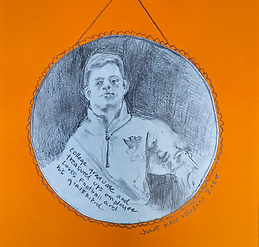
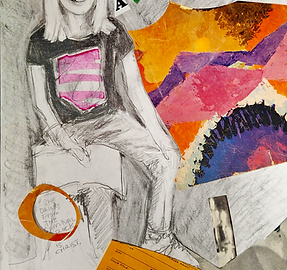
Into the Hinterlands - A Visual Diary of Previously Uncharted Portraiture and Its Subjects
Julie Nelson (2024)
We are the Sojourners.
We go into the Hinterlands, beyond what is visible and known.
We hike into the Fertile Valley of Ideas.
We bear witness to Fellow Travelers and the World's Citizens.
We return with Roadmaps for Future Pioneers.


How on Earth
Gaby Wolodarski (2024)
Biography
Gaby Wolodarski is a Swedish/American artist based in California and Alabama. Her
paintings and installations use a mix of humor, abstraction, figuration, and trompe l’oeil
to probe fictions and contingencies of the contemporary human psyche, foregrounding
ways in which the visible world is subject to pressures from our language-oriented
brains. She holds a BA in Art Practice from UC Berkeley and an MFA from Cornell
University. She has exhibited locally, nationally, and internationally in spaces including
Hatch, Rock Paper Scissors Collective, Yerba Buena Center for the Arts, Southern
Exposure, the Di Rosa Preserve, the Wiregrass Museum of Art, and the House of
Humour and Satire. Recent solo exhibitions include Honey Blips at Sunday Takeout in
Brooklyn, NY, What Are We Making Waking at The Range in Saguache, CO, Pigurative
Faintings at the University of Montevallo, AL, and Nice’n’Dark at HPL Galleries in
Hoover, AL. Her most recent two-person exhibitions, with April Bachtel and Amy
Feger, in Birmingham and Montevallo respectively, address questions of belonging,
signification, correspondence, ecology, and land stewardship. She currently teaches
drawing and painting at the University of California, Davis.
Artist Statement
In putting together the exhibition How on Earth, I keep asking myself questions that
seem both age-old and urgently “now.” How to be? How to make art? How to be
clear, in my thoughts and in language, about the impossible complexity of existence?
I wanted to make a series of pieces that were at once very specific (full of signifiers,
symbols, signs, stuff, baggage) and at the same time very open to interpretation
(empty, free). We human beings live in very strange times. Climate change and its
concomitant wars and mass migrations, late capitalism, the endless reification and
monetization of every corner of lived experience, techno-acceleration, the resurgence
of the far right––these are circumstances for bewilderment and despair. My humble
hope for the medium of painting is that it can nurture a quietly humorous, gentle
awareness of the extent to which we are all implicated with one another and one
another’s perceptions. The writer Thomas Mann’s insight post-WWII seemed to be, that
extricating oneself is impossible: “It is all within me. I have been through it all.” He was
speaking about Germany as a German, but I think it could apply to us earthlings as
earthlings.


In Transit
Erin Kirk (2024)
Erin Kirk is a contemporary visual artist, author, and rising NYU graduate. Through her unique blend of artistic mediums, Kirk explores the intersection of nature and human emotion. Her vibrant, surrealist oil paintings evoke an ethereal sense of wonder and awe, while her poetry delves into the depths of the human experience. Inspired by the spiritual beauty of her surroundings in Alabama and New York City, her work reflects a deep connection to the natural world. With each brushstroke or carefully crafted word, she invites viewers to contemplate their own place within the intricate tapestry of life.
LEARN MORE HERE
INSTAGRAM: www.instagram.com/erinkirk.art
TIKTOK: www.tiktok.com/@erinkirk.art
PROPER WEAPONS BOOK: www.amazon.com/Proper-Weapons-Erin-Kirk/dp/B09PVZZTLS


A Continuing Process
Cinthia Kapser (2024)
I make impressionistic paintings and realistic sculptures which reflect the beauty and mystery I see in animals and nature. The current mediums I utilize are oils, acrylics, and polymer clay. My desire is for the viewer to experience my vision of the wonders in nature.
I am a native Texan and spent my early years in the San Antonio and Galveston Bay areas. The beauty of the Texas Hill Country and the beaches
as well as wildlife reserves of Galveston Bay sparked my interest in painting landscapes and waterways. Multicultural events such as Fiesta San Antonio, with the bright colors and patterns, influenced my love of rich color.
My current residence and studio are at the McFarland Farm in Rainbow City, Alabama. The constantly changing scenery of the farm, the surrounding Appalachian foothills, and the Coosa River inspire me daily.
Throughout my life I have been fascinated by animals, both domestic and wild. Dogs are my particular passion and I've been active in training, showing, and rescuing them throughout my life. Some of my subjects are dogs, fostered or rescued by my family and friends.
Even though I raised a large family and had a nursing career, producing art
has remained a constant and continuing process in my life. Family and friends continue to be supportive of my art. My art education has been self-directed through classes, workshops, and videos. I am now focusing on creating commissioned pet portraits and memorials, in addition to exploring
wildlife subjects.


Carrollton | Gadsden Artist Swap
Carrollton Artist Guild (2024)
Carrollton Artist Guild
Since its inception on January 22, 2003, the Carrollton Artist Guild's goal has been to support public awareness of the arts. strive to provide encouragement and opportunities for artists to promote, exhibit, and sell their artwork. The guild provides ongoing education for members through monthly lectures and demonstrations. The group also works with local venues for shows and other displays throughout the year, including an artist co-op gallery in downtown Carrollton.
What is the Art Swap Program?
This annual program invites artist and art organizations within the region an opportunity to show their members’ work in a venue outside of their county by trading spaces with the Carrollton Center for the Arts (CCA) and Carrollton Artist Guild (CAG) for exhibitions of each others’ local artists. This allows visitors in each city to meet new artists they may not otherwise have the chance to see, while allowing artists the chance to meet new potential patrons.


Wild Alabama: Conservation Through Art - Saving Alabama's Hemlocks
(2024) Gary Anderson, Anne M. Bailey, Janice Barrett, Elaine Booth, Sam Calhoun, Paulette Daniel, Jim Felder, Leisha Hultgren, Timothy M. Joe, Maggie Johnston, Bryce Lafferty, Allison McElroy, Erin Morris, Linda Munoz, Yuri Ozaki, Charles Siefried, Jillian Sico, Beth Stewart, Starr Weems
Wild Alabama's mission is to inspire people to enjoy, value, and protect the wild places of Alabama. They strive to engage people in a variety of ways, year-round and in all kinds of environments, from virtual to the deep wilderness. Learn more about Wild AL on their website: www.wildal.org
Artist Statement
This exhibit is rooted in each artist’s and poet’s intimate relationship with the eastern hemlock forests of northwest Alabama where the hemlock trees are among the few populations currently unaffected by the Hemlock Woolly Adelgid, a non-native invasive insect that has decimated the hemlocks up the Appalachian chain from east Alabama into Canada. Eastern hemlock (tsuga Canadensis) is an evergreen tree that is a foundational species in its ecosystem, a relic from before the last Ice Age that profoundly influences terrestrial and aquatic life.
Born of Wild Alabama’s community science program Save Alabama’s Hemlocks, the aim of this exhibitis to educate about the beauty and importance of Alabama’s hemlock forests, and the deadly threat of the Hemlock Woolly Adelgid.
The exhibit is an art show of paintings, photographs, handmade paper, book art, glass and poetry by Alabama artists that explores the power and beauty of the Eastern Hemlock ecosystem under threat. There will be workshops, a poetry reading and artist talks during the run of the exhibit.
"What we love, we protect. Wild Alabama’s hope is that viewers of this exhibit come to love these forests as we do, and in the process, join us as forest protectors in the ways that make sense for them. The time is always now." (Janice Barrett)
Wild Alabama is a 501-c3 non-profit forest protection organization working primarily on the Bankhead and Talladega National Forests, Sipsey Wilderness, Cheaha Wilderness and Dugger Mountain Wilderness.
Wild Alabama’s mission is to inspire people to enjoy, value and protect the wild places of Alabama.


Queer Impressions
Josh Hoggle (2024)
Artist Statement
Josh Hoggle, a Birmingham-based artist, is a skillful explorer of the nuanced interplay between identity, nature, and the human experience through his artistic endeavors. His paintings intricately weave together themes of nature and the human figure, capturing the beauty of human anatomy. Hoggle's meticulous studies delve into the mesmerizing dance of light with skin, architecture, and the diverse elements that surround us. Through a diverse range of mediums, including oil painting and film photography, he crafts a narrative that transcends conventional boundaries. Inspired by personal experiences, cultural influences, and the ever-evolving tapestry of artistic movements, Hoggle's work is an evocative amalgamation of introspection and aesthetic allure.
In addition to his fine arts prowess, Josh Hoggle extends his artistic vision to prop styling and still life tabletop photography. As a prop stylist, he crafts visual narratives with meticulous attention, using objects to enrich each frame's storytelling. Hoggle's foray into still life photography showcases technical expertise, a keen eye for composition, and the ability to infuse inanimate objects with narrative resonance. Seamlessly blending fine arts and photography, he demonstrates versatility and a multidisciplinary approach to artistic expression.


Anthropomorphic Daydreams
John Klosterman (2024)
Artist Statement
As an artist, I use my work as a means to explore, examine, and rationalize concepts while processing information. This body of work in particular reflects on my complex relationship with nostalgia and familiar icons. My imagery is drawn from the use of anthropomorphic figure-building and associations between family members and specific animals. These associations come from a mix of personal history and traditional stories.
Linoleum-carved coyotes serve as an embodiment of curiosity, and exploration, and possess a trickster nature. I drew inspiration for these figures from writings such as Lobo the King of Currampaw and Silverspot, the Story of a Crow to illustrate complicated relationships with friends, family, and places. I laboriously draw schematics and diagrams as trace monotypes over top of chemically transferred landscapes. This consistent disassembly and reassembly of imagery creates additional visual context for each piece to be viewed as a separate entity from the original pieces. The appropriation of these captured moments allows me to curate a scene and give new context. Through the use of archetypal stories and personal imagery, the work invites viewers to use my nostalgia as a gateway in their own.
Artist Bio
John Klosterman is a full-time instructor in Drawing and Foundations. He is a native of Daphne, Alabama. He attended the University of South Alabama, where he earned a BFA in Printmaking. He then attended the University of Alabama as a graduate teaching assistant and earned his MFA.
Growing up, he developed a fondness for machines and all the tinkering that came along with them. His love of tinkering now takes on a two-dimensional form as he transfers ink to paper. Instead of the turn
of a wrench, it is now the carving of a block with a gouge. Layers of each print, much like parts to a car, are assembled in a manner that creates a functioning vehicle for the message of each piece.
John uses his work as a means for a thorough self-examination. The use of family photographs and memories affords him the opportunity to derive meaning from his upbringing in the rural backwoods of Alabama into an artist. He uses vintage inspired iconography as a reflection on his own surroundings growing up as a child raised by his grandparents. John realized that while he may not work amongst engines and diagrams still, he now surrounds himself with his own structures. Just like the never-ending cycle of upkeep on machinery, He consistently plys his trade into each piece of art in search of some form of rigid idealization. Johns goal is to know if he has built his own “vessel” to plan.


Memento Morididdle
Charles Clary (2024)
Biography
Charles Clary, he/him, was born in 1980 in Morristown, Tennessee. He received his BFA in painting with honors from Middle Tennessee State University and his MFA in painting from the Savannah College of Art and Design. He has shown in exhibitions at Galerie Evolution-Pierre Cardin in Paris, France, The Netherlands’ CODA Museum Paper Biennial in 2021, The Shanghai Paper Biennial in 2021, Art of Paper Fair in New York City, and many other international, national, and regional juried, group, solo, and museum exhibitions. Clary won Top Prize at the 2016 ArtFields Competition in Lake City, SC, and in 2019 he won both People’s Choice Award for 2D and the Merit Prize at ArtFields. He recently sold three commissioned pieces to Google corporate offices, and he was named the HTC Distinguished Teacher-Scholar at Coastal Carolina University in 2022, the highest award bestowed upon a faculty member by the university. Clary has been featured in numerous print and Internet interviews including, Create! Magazine, Candyfloss, This is Colossal, WIRED magazine (US and UK), Hi Fructose, Beautiful Deay, and Bluecanvas Magazine. He has also been featured in publications including 500 Paper Objects, Paper Works, Paper Art, Papercraft 2, and PUSH: Paper.
Charles has exhibited regionally, nationally, and internationally in numerous solo and group shows, is represented by Paradigm Gallery + Studio in Philadelphia, Art Space 305 in Miami Florida, and R02 Gallery in Dallas, Texas. Clary currently lives and works in Conway, South Carolina, where he is an Associate Professor of Studio Art and Foundations Coordinator at Coastal Carolina University.
Artist Statement
My work stems from the loss of both my mother and father due to smoking-related cancers in February of 2013. Their passing left a deep void in my life that led to my interest in Memento Mori, remembering that one day you will die, and a reinvestigation of my own childhood trauma, abuse, and mortality. Through these investigations, I came to terms with the trauma of my childhood and the lack of memories I actually have. Picture frames are usually reserved for those most cherished of memories: a family outing, birthdays, weddings, or holiday get-togethers. They rarely encapsulate the most influential events: a death in the family, trauma, or abuse.
My work seeks to investigate these moments as they force us to make decisions, decisions that lead to life-changing events. We either rise to the occasion or sink into despair. Pulling from the ideation of mourning jewelry, hair wreaths, and Victorian sitting rooms, my work mimics and encapsulates trauma within the fragility of paper.
Video: https://youtu.be/9OIrIj7ihM0


Color Stories
Studio by the Tracks (2024)
Participants:
Jason Bryan, Alan Poole, Ann Perkins, Dennis Brown, Garrett Bailey, Mychal Hicks, Mychal Hicks, John Miller, Byron Pickett, Skye Windham, Henley Hager, Art Horton, Ruth E. Troyanek, Tynesha Carlton, Jasmin Clay, Michael E. Moore, Patricia Hefner, David Powell, Michael Hall, Jon Faulk, John Miller,
Ken O'Laughlin, Mark Porch, Austin Thrasher, Jon Faulk, Brittany Dunn, Garrett Bailey, Skye Windham, Sydney Windham, Ann Perkins, Xan Young
Studio By The Tracks (SBTT) is a community arts studio serving artists on the autism spectrum. The Studio provides opportunities for social connection and creative expression in a supportive, inclusive environment with all materials and instruction offered at no cost to Studio Artists. All the work in Color Stories originates from our core adult programming, serving more than 50 artists weekly in the Birmingham area.
Communication in the Studio happens in many different ways–as many ways as there are people in the room. But in a space dedicated to visual art, color is a common vocabulary. And in a community of artists, if not the world, colors tell stories. The works in Color Stories speak to the many ways color functions for our artists and their practice. At SBTT in particular, the community studio space has evolved to support neurodiverse makers and artists on the autism spectrum for whom traditional speech and language may be processed differently.
Some SBTT artists create worlds and then color them, while others build entire worlds of color itself. Some favorite hues are stalwart and act like anchors for the artists. Some preferences change like the seasons or emerge as trends, creating serendipitous connections across the studio community. This phenomenon speaks to a dynamic conversation between individual artistic expression and collective influences, exemplifying how artists may draw inspiration from each other in addition to broader cultural movements. It is our hope that you, as the viewer, take something from each piece – each color, each juxtaposition and interplay – and that you see color stories emerging in your own life.
LEARN MORE about SBTT by visiting studiobythetracks.org


Last Time We Spoke
Miriam Omura & John Paul Kesling (2024)
Miriam Norris Omura
Biography
Miriam Omura (b. 1980, UK) was born in southern England and immigrated to the US as a child. Miriam holds a BFA in Fiber and Material Studies from The Cleveland Institute of Art and a MA in History and Art History from Cleveland State University. After a 10 year career in museum collections across the US she decided to renew her studio practice full time. Omura has also studied weaving in Kyoto, Japan.
Artist Statement
Her practice includes textiles, ceramics, and alternative photographic methods. Her material processes are guided by a commitment to research, delving into newspaper archives, genealogy, and various resources to unearth narratives within her work. Exploring themes of personal and community loss, as well as identity, Omura navigates the known and unknown details surrounding missing and unidentified individuals. Her art looks at the intersections of materiality, history, and emotion. Her works serve as both a tribute to loss and a reflection of threads that connect us all.
All Omura’s work pulls from a root of lost or missing people in her own family history and an innate desire to better understand their stories. Omura’s work Those Not Found (Alabama’s Missing) is a changeable piece that grows and shrinks as people are listed as missing or are removed from missing persons lists. While most of her works look at individual missing or unidentified people, this work looks at Alabama’s missing as a whole. The work comes from wanting to acknowledge the many individual stories of missing people. No one person is given more importance over another and the tiles include those who will never be found, those whose stories are well known and those who are overlooked.
John Paul Kesling
Biography
John Paul Kesling (b. 1980, USA) was born and raised in Northeastern Kentucky in the foothills of the Appalachian Mountains. He received his BFA in Arts from Morehead State University, and spent a summer in Europe studying art history. He went on to receive his MFA in Painting from The Savannah College of Art and Design. He spent the next six years in Brooklyn, NY immersed in the NYC art scene. In March of 2016, while attending a month-long residency at The Vermont Studio Center he realized how integral time, space, and nature were to his studio practice and in 2016, relocated to Madison, TN, just outside of Nashville.
Artist Statement
My practice delves into the complexities of human intimacy, both romantic and familial. After the death of my younger brother and many of my friends to the ongoing opioid epidemic of my Appalachian hometown, the country at large, my own mortality is embedded within the mark-making. Driven by a need to understand the world around me, my work serves as a visual exploration of the emotional and psychological intricacies of intimate relationships, personal loss, and our place in the natural world. Imbued with a deep sense of nostalgia, the work harkens back to the excitement and vulnerability of new human connections and experiencing nature in a new light. For me, painting is as necessary as digging in the dirt - dragging your hand through a body of water - across a freshly buzzed head.
In 2004, I lost my younger brother to his years-long struggle with opioid addiction. He was only 23 years old. We grew up in a small Appalachian town in Northeastern Kentucky. Industrial and coal-dependent, Ashland, Kentucky was ground zero for the start of the opioid crisis in the late 90s. The 2017 Netflix documentary Heroin(e) featured nearby Huntington, WV, just ten miles away. That city has been dubbed “the overdose capital of America” where the overdose rate is ten times the national average. In the years that have followed the problem has only gotten worse. In my hometown of only 20,000 people, the effects of this addiction hang in the air of the Ohio River Valley. Through portraiture, I want to bring humanity to those we lost to opioids. They were spouses, mothers, fathers, grandparents, children, grandchildren and friends and they were loved. Representing the fugitive beauty of a life, they're painted in haste, half from life and half from memory in the same way we remember lost loves.


Shadow Lands
Lee Somers (2024)
Artist Statement
In the summer of 2023, I spent three months traveling in Japan on a Creative Arts Fellowship provided by the Japan-US Friendship Commission. At one of many museums I visited on my journey, I saw a folding screen: a tall, long one depicting a raised garden boardwalk cutting through sprays of purple iris flowers, its meandering path receding diagonally into the implied distance. The imagery was rendered in flat, spare colors in a minimal style, feeling almost cut-and-paste atop a backdrop of gold leaf. Animated by the angles of the screen pushing and pulling the boardwalk in and out of the fore, boundaries between image and object blurred. Walking the length of the screen, the pictorial logic overlayed on the undulating surface created peculiar alignments and a remarkably deep, immersive viewing experience. Evoking the sensation of moving through space, the screen opened the door to an imaginary realm.
On returning to my studio, I began unpacking the overstuffed suitcase of ideas and inspirations I brought home. After many sketches and false starts, I returned to the screen which had so captivated me. I chose to explore this format, interpreting the bridge and thirty-degree folds of the screen as a physical object. I traced horizon lines from my trip photographs, cut them from wood, and used them to build a landscape of layered topographies on the bridge top. In my homage to the screen, I am processing the still-fresh experience of being in Japan. I began thinking about shadows, their graphic, flat quality; their ability to project images onto objects, and the transformative potential of the paring. The iris and bridge struck me as a kind of shadow, a projection of reality on a real surface. This reminded me of Plato’s cave, with shadow projections depicting a partial reality on the wall. Along this line of thinking, I see this work as an exploration of the space between perception and reality, imagination and memory. A journey into the shadowlands.
Biography
Lee Somers hails from the southwest, his formative years framed by a backdrop of mountains and deserts. With a neighbor who ran a production pottery, Lee began working with clay at an early age. In pursuit of this passion, he ventured to New York state to study ceramics at Alfred University. Lee ended up spending ten years there, off and on, earning both his undergraduate and graduate degrees, and working as a collaborative assistant to Wayne Higby in the production of two large porcelain murals. During this time, he took a series of trips to China to further his studies of ceramics as an intern, residency coordinator, and finally as a visiting professor of ceramic design at the China Central Academy of Fine Arts, Beijing. In 2012, Lee took a position teaching at the University of Montevallo where he continues to work as a professor of art. He and his family live in Birmingham.
While ceramics continues to be integral to Lee’s creative practice and research, he works in a variety of media including printmaking, digital design and fabrication, and wood. Lee’s work explores landscape at the intersection of natural and cultural history. For him, the landscape is a space to examine the complex relationship between person and place. Lee has work in the permanent collections of the Shanghai Craft Museum, Burchfield-Penney Arts Center, Greenwich House Pottery, Alfred Museum of Ceramic Art, and the United States Embassy in Beijing. In the summer of 2023, Lee spent three months in Japan on a research fellowship awarded by the Japan-US Friendship Commission. He works from his studio on the campus of the University of Montevallo, enjoying the overlap between teaching and making.


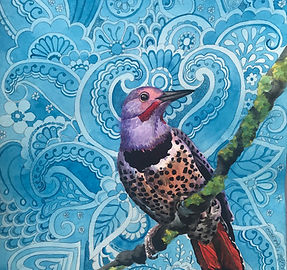
Body and Soul
Laura Walker (2024)
I am interested in using my art to express emotions. My Body and Soul Show shows the growth of my artistic style. This collection developed through the years as I was actively selling a completely different body of work. These meaningful pieces didn’t go with any of my other art. I didn’t know what to do with them, but I knew I needed to make them.
I started with people, exploring relationships. Sometimes I would layer words all over the drawings, sometimes they were more traditional portraits. However, I was always interested in connecting emotionally with my viewers.
Eventually, I did a portrait with a detailed background full of stylized designs to represent Joy. This portrait led to several years of my painting animals with these more involved backgrounds, hiding positive words in the art, and the animals representing different emotions.
In 2021 I painted my New Year’s resolution, a watercolor of an anatomical heart surrounded by zen tangle-style flowers, with the promise that God heals the brokenhearted. I was intrigued by the Eastern Medicine concept of how our emotions are tied to certain organs so I explored that concept visually. I continued hiding positive words in the art and have worked visual symbols into several of the backgrounds. I also started painting the herbs that aid the qualities that I’m representing as the backgrounds.
I hope my Body and Soul Show helps you to find encouragement, joy, and peace. I do art with emotion, art with meaning, art with a soul.
If you want more information or are interested in purchasing any of the art, you can contact me at lostlaw95@yahoo.com. Use the QR code to see these paintings in my online shop.


True Colors
True Colors - Etowah County Board of Education (2024)
The True Colors Art Program's exhibit features student artwork from Gaston High School, West End Elementary, and West End High School.
Gaston High School
Gabriel Jacobs – 9th Grade
Olivia Howard – 9th Grade
Nya Gatlin – 9th Grade
Eddie Godfrey – 8th Grade
Destiny Kinney – 9th Grade
Kaydence Allen – 9th Grade
Lacey Stone – 7th Grade
Saeryn Taylor –10th Grade
Charlie Hodge – 7th Grade
Zaniya Riddle – 7th Grade
Autumn Leach – 7th Grade
Asia Malone – 7th Grade
Victoria Martin – 7th Grade
Adrianna Garrard – 9th Grade
Kiara Moon – 8th Grade
Nivea Horton – 8th Grade
Felix Tomas – 7th Grade
Brylie McCarver – 10th Grade
Ally Chapman – 7th Grade
West End Elementary
Krimson Tims – 4th Grade
Karma Dillard – 4th Grade
Makenna Cancino – 4th Grade
Dawson Chastain – 4th Grade
Abby Carter – 4th Grade
Divinity Tabb – 4th Grade
Delilah Cass – 5th Grade
Briley Conn – 5th Grade
Samantha Greeson – 5th Grade
Cadence Howard – 5th Grade
Liana Markley – 5th Grade
Koy Moore – 5th Grade
Aden Holliday – 6th Grade
Lillian Ladnier – 6th Grade
Solomon Reneau – 6th Grade
Dalton Copeland – 6th Grade
Trevor Leigh – 6th Grade
Brianna Britt – 6th Grade
Carson Gibson – 6th Grade
Jace Pounds – 3rd Grade
Gunner Hill – 5th Grade
Montana McCay - 4th Grade
West End High School
Olivia Argo – 7th Grade
Ian Kerr – 7th Grade
Emilia Cruz – 7th Grade
Sophia Howell – 7th Grade
Ada Collins – 7th Grade
Kaylee Contreras – 7th Grade
Annslee Hampton – 7th Grade
Katrina Holmes – 7th Grade
Mikayla Jones – 7th Grade
Makynzie Williams – 7th Grade
Nataly Garrido Cerino – 7th Grade
Adyson Dunlap – 7th Grade
Levi Loftis – 7th Grade
Alexis Brown – 7th Grade
Aubery Callison – 7th Grade
Bella Wyatt – 7th Grade


GMA Children's Show
GMA Children's Show (2024)
2024 Student Show Winners
5K
1st – Tristan McNamara (Frog)
2nd – Amelia Blume (Unicorn)
3rd – Isabelle Uy (stars)
HM – Tristan McNamara (dog)
HM – Caroline Moore (butterfly)
1st
1st – Benjamin Melo (octopus)
2nd – Khloe Sandridge (owl)
3rd – Barret Bowman (owl)
HM – Addie Garrard (dolphin sunset)
HM – Tristyn Jones (self-portrait JR 16)
2nd
1st – Isaac Allred (flowers)
2nd – Winter Jiang (rabbit)
3rd – Ceres Steapleton (landscape & house)
HM – Winter Jiang (self portrait)
HM – Finlay Gilchrist (collage animal)
3rd
1st - Benton King (pelican)
2nd – Christopher Ragland (parrot)
3rd – Avery Dingus (Abe Lincoln)
HM – Henley Terrell (Jesus)
HM – Alayna Meadows (starry nite)
4th
1st – Jackson Allred (dragon hands)
2nd – Caroline Millican (giraffe)
3rd – Cara Jaeckel – (books painting)
HM – Kimber Wilkins (robot take over)
HM – Cara Jaeckel (constellations)
5th
1st – Harlow Ford (Pumpkin)
2nd – Garrett Gasser (colorful raindrops)
3rd – Harlow Ford (FNAF cat )
HM – Emma Douglas (eye)
HM – Evelyn Wilson (abstract on left of vinyl)
6th
1st – Charlie Delilla (Me)
2nd – Talya Thomas (rainbow stripes)
3rd – Nancy Guerrero (apples)
HM – Charlie Delilla (Moth)
HM – Prince Graham (Night city)
7th
1st – Amanda Smith (burning city)
2nd – Claire Wilson (window box)
3rd – Jaclyn Johnson (self)
HM – Dylan McDaniel (landscape)
HM – Nisakon PongPang (girl)
8th
1st – Kaylon Duke (red & black fire)
2nd – Corey Wilbanks (male upper body)
3rd – JaMia White (big head)
HM – Corey Wilbanks (3d squares)
HM – Gary Williams (nature collage)
9th
1st – Madeline Phillips (manger scene)
2nd – Saudeyah Craft (Girl with pearl
3rd – Kyleigh Williams (dog)
HM – Alexis Estes (spaceship)
HM – Saudeyah Craft (pencil girl)
10th
1st – Landon Kircus (tree photo)
2nd – Maria Gaspar (apples)
3rd – Jasmine Lopez (last of us guy)
HM – Iiyanna Simmons (photo thru glass)
HM – Annabelle Smith (shark)
11th
1st – Bradon Gibbs
2nd – Ashley Pankey (Lighthouse)
3rd – Jackie Burns (painted fish)
HM – Alex Hill (photo kids at computers)
HM – Macey Hamilton (old man drawing)
12th
1st – Sam Bouvier (lion)
2nd – Kimberly Lopez (kitten drawing)
3rd – Li Joyner (Leaf photo)
HM – Carley Zmolek (bottle and flower drawing)
HM – Breanna Lacks (snake) HM – Ash Gallardo (large printed drawing)
Ceramics/3D
Elementary
1st – Sebastiana Jimenez (paper flower)
2nd – Katelyn Uy (farm animals)
3rd – Aubrey Henderson (cake)
HM – Parker Bennett (mushroom)
HM – Makayla Sickles (fish)
HM – Charles Tongsuvone (Queen Mary)
Middle
1st – Vayda Clay (flowerhead)
2nd – Bentlie Blevins (box)
3rd – Amanda Smith and Evelyn Wilson (alien head)
High School
1st – Alexandria Smith (book with flower papers)
2nd – Suzie Frederick (siren/mermaid)
3rd – Joshua Coley (mushroom house)
HM – Keerthana Tummala – (light blue vase)
HM – Angel Smith (Elephant)


Just Down the Road
Gina Brown (2024)
ARTIST STATEMENT AND BIOGRAPHY
What inspires me to paint: My family and friends. The landscape — not just the beauty I see, but the way a place sounds, the air I breathe in and smell, the way it makes me feel. A good book, poem, or song. Flowers and animals. The smell of oil paint and the way a long-handled paintbrush feels in my hand.
If you look closely at my work, you’ll see imperfections. Sometimes my art looks unfinished. I embrace it. I paint loosely and simply, and I want my paintings to offer a quiet pause to the viewer.
I have always loved to draw and paint, and I was encouraged by my parents and grandmother at an early age to pursue art. Before I began painting full-time, I dreamed of a verse in scripture, “Aspire to live a quiet life, to mind your own business, and to work with your own hands.” I didn’t really know how that verse would come to impact my life and art as much as it has. I’m a believer and follower of Jesus Christ, working with my hands for His glory, not mine. I hope to bring others closer to Him through this gift of art.
Gina is a fine artist living in Glencoe, AL. She has been chosen as a signature member of the American Impressionist Society and is represented by Shain Gallery in Charlotte, NC, and Beverly McNeil Gallery
in Birmingham, AL.


Looking Out My Back Door - Creatures of the Pandemic
Charlie Webb (2024)
Artist Statement
In March 2020, the COVID-19 pandemic brought everything to a standstill. After a month or so of staying around the house I was about to go crazy, and then one spring morning I looked out into my backyard. I saw three different species of birds that I had never really paid any attention to in the 27 years we had lived here. I grabbed my camera and headed out. I quickly learned that photographing birds is a whole different ball game than Civil War Reenactments or Indy car Races. They are small, move fast, and move unpredictably. They fly quickly from light areas to dark shade. I also realized that my lens was woefully inadequate. I like a challenge though and over the next several months I upgraded my equipment, watched a lot of YouTube videos, and noticed a significant improvement in the photos. I liked what I saw. As things eased up a bit a friend and I made several trips up to Guntersville to see and photograph the bald eagles there. I had never seen them in the wild before and that first time seeing one flying slowly along the lake shore was breathtaking, to say the least. That lockdown opened a whole new area of interest that is still going strong today. When I decided to do one more photo exhibit the choice was obvious. Please enjoy these photos of life in my backyard with a couple of Guntersville eagles thrown in as well.
Biography
Charlie Webb was born in Denver, Colorado in April of 1952. After graduating from Northglenn High School in 1970 the government invited him to leave home and accept their generous job offer with the United States Army. For the next 23 years, he traveled around Europe and various locations in the United States. He always had a great interest in photography and during this period used every opportunity to document his travels. Following his retirement from the Army he worked as a government contractor at Fort McClellan in the battle simulations center. When Fort McClellan closed in 1999, he got a job with Westinghouse as a control room operator at the Anniston Chemical Weapons Disposal Facility where he spent the following 14 years helping to safely eliminate the over 600,000 obsolete chemical weapons that were stored at the Anniston Army Depot. Since he retired from Westinghouse in 2013, he has had much more time to indulge his hobby focusing on Nature, Portraits, Civil War Reenactments/Military subjects, and Sports with emphasis on the annual Indy Car Race at Barber Motorsports Park in Birmingham. Beginning in March 2016 he has also provided, on a volunteer basis, photographic support for the U. S. Army Museum Support Center at the Anniston Army Depot. In 2018 the Army recognized his efforts by awarding him the Public Service Commendation Medal. He has been married to his wife Mary for 45 years and has three adult children, two grandchildren, and a schnauzer named Maggie.


Through the Lens
Shelby County Camera Club (2024)
Fourteen photographers participated in this exhibition of black and white and color photography of diverse subjects.
PARTICIPANTS
Bob Gross
Butch Oglesby
Charles Duncan
David M. Frings
David Green
Glenn Wills
Hank Siegel
JoPaul Cates
Linda Wurstner
Louis Smith
Madelyn Carr Bonnett
Mike McGary
Phillip M. Burrow
Ted Vodde
Video: https://youtu.be/ytv19Lmyfc4


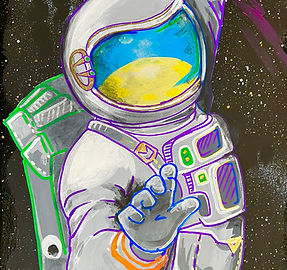
Mixtape Future
Kris Catoe (2024)
The body of art created just for "Mixtape Future" speaks from the different seasons in the life of its artist, Kris Catoe. Kris grew up with an analog childhood. His imagination would grow without a cord connected to an outlet. Today, he puts a colorful breath on all he touches.
Art all around. Kris Catoe grew up in a creative home. He began finding his voice of expression in 1987. Today, he reaches into all types of art to learn, stretch and grow. His paintings, murals and assemblages tell the stories from the beautiful life he sees all around.
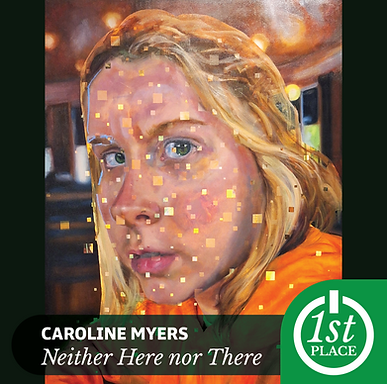


STofART UAB
UAB Juried Show (2024)
STofARTholds is a juried exhibition of current and recent graduates from the University of Alabama at Birmingham’s Department of Art and Art History. The exhibition simultaneously serves as a recruitment tool as well as excellent training for students developing professional practices beyond the classroom/studio.


Beyond Indigo
Baggs McKelvey (2024)
Artist Statement
I am primarily interested in using discarded, mass-produced, and crowd-sourced materials to create installations, sculptures, and mixed media artworks. My process is a playful and repetitive investigation of the poetic and formal aspects of material, space, and form. Objects and materials are chosen specifically for inherent meaning. Environments are built, consumer objects are placed in the landscape, and organic forms are chosen and then subverted by the materials used.
Found objects and crowd-sourced jeans feature broadly in my work from 2020. Denim is durable, comfortable, sometimes sexy, but always casual. It has a long history and many perceived meanings. It references the body, gender, beauty, industry, history, commerce, and much more.
The denim installations are site-specific, responding to the architecture of the exhibition space and defined by contour lines sourced from aerial photos and maps of the surrounding land or cityscape. While researching a location I target local waterways and migratory passages as potential sources.
The denim is pulled tight between the walls of the space, tracing the contours of each line, creating a dynamic form. Crowd-sourced from family, friends, and social media, each pair are cut into strips and tied together to create a single length of denim rope. The process of cutting, knotting, and spinning the fabric strips onto cable spools is a re-thinking of typical women's work.
The sculptural elements are inspired by many things including the artwork of Georgia O’Keefe, politics, feminism, motherhood, and my place within the culture of the Southeast and the nation. These works are made intuitively, responding to the objects while considering symbolic, formal, and aesthetic combinations and forms.