.png)
2023 Exhibition Catalog


Barbie's Dreamhouse
Ali Hval (2023)
Barbie's Dreamhouse presents a playfully pink space composed of glittering objects inspired by clothing and home decor. Upon closer inspection of these frilly and sparkling works, more sinister and restrictive undertones are revealed. The works exhibited reflect current political struggles regarding women in the United States as well as ways in which the female body is critiqued.
ARTIST STATEMENT
Growing up in the southern US, I quickly learned there was a certain expectation of how to "properly" be a woman: now, I challenge what that looks like using performed femininity as a tool to reveal not only gender disparities, but also to illuminate the relentless critique and politicization of the female body. Instead of hiding or denying femme aesthetics and female sexuality, my pieces embrace, highlight, and empower then, while acknowledging all the awkwardness, humor, and theatricality they entail.
The work in this exhibition is flirtatious, attention-seeking, and deceptively superficial. Toying with their own actualities and potential, they can speak - glittery and powerful - to politics in their own voice: excessive, unabashedly hyper-feminine, and most importantly, PINK.
Video: https://youtu.be/n5FF7yfzAVs


Patterns and Perceptions
Carol Hill (2023)
Artist Statement
I am fascinated by the beauty of natural forms. Much of my inspiration comes from the patterns and designs found in shells, the organic lines of nature, such as seed pods, leaves, and flowers, and the geometry of rock formations. I use acrylic paint and multimedia composition to create the symmetry, design, and organic form arrangement in my current work.
The result is a fusion of colors, patterns, and shapes that blur the boundaries between the familiar and the mysterious. Through the juxtaposition of pattern and organic shape, my goal is to create a sense of wonder and a connection with the world around us.
I strive for my art to serve as evidence of the beauty and complexity of the natural world by exploring it's intricate patterns and designs. I aspire to create a sense of harmony between the organic and inorganic. The combination of colors, patterns, and shapes in my work is a reflection of the diversity and richness of this awe-inspiring world.


Go Ethereal
Hannah Hill (2023)
Artist Statement
In my paintings, I'm attempting to create a veneer of an alternate world. An ephemeral plane made up of dualities, of residual traumas made poetic. All of my imagined worlds draw from my personal experiences, desires, and fears, but also my favorite curiosities; archaeological finds, folklore, ecologies, ancient societies, medieval manuscripts, etc. These vastly different interests, combined with a penchant for self-reflection and my upbringing in the foothills of Appalachia, cast unusual imagery of figures, landscapes, fauna, flora, and relics. The result is forged personal mythology, where elements of the 'real' world and the supernatural are intertwined.


Hive Mind
Braden Gibbs (2023)
Braden Gibbs is a junior at Etowah High School. His series, Hive Mind, is a collection of drawings made with pen, ink, pencil, and watercolor.
ARTWORKS INSPIRED BY:
V1 from Ultrakill
The Janitor from Little Nightmares
Doom Eternal
SCP-049 Plague Doctor
Slenderman
Uzumaki by Junji Ito
Eye of Cthulhu from Terraria
Portrait of PewDiePie alongside Miscellaneous
Game Characters

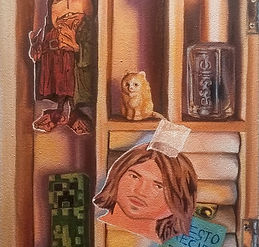

Amalgamations
Abigail Henderson (2023)
This exhibition focuses on two distinct bodies of work: The Climbing Series and The Amalgamation Portraits.
Although we see ourselves as unique, we all take influence, whether we know it or not, from everything around us. As Maya Angelou said, "You are the sum total of everything you've ever seen, heard, eaten, smelled, been told, forgot - it's all there..." My subjects strive for independence and individuality, all the while borrowing from those who came before them.
The Amalgamation Series is an exploration of identity, idiosyncrasies, and the universal longing for individualism. Historically, portraiture is a way of keeping a record of the likeness of important figures. Portraiture can also be a means of portraying the subject as more than a vessel, conveying a deeper message about the sitter, whether flattering or not. This could include the sitter's importance, power, wealth, beauty, or virtue as well as greed, self-importance, and egotism. Collectively they reflect who we are as people and the influences that make us who we are.
The Climbing Series takes human figures out of their natural environments and places them into a realm where reality is obscured. They are seemingly trapped in time, playing through a sequence of movements while at the same time completely still. These paintings reference the tangible and intangible, and the juxtaposition of the human form with an atmosphere of solid color. The interaction of these figures, or lack of, with their environment highlights the very ambiguity of where they
find themselves.


Shared Beginning Diverse Creations
(2023) Participating Artists: Izabella Janush-Hernandez, Sydney Marlin, Alexa Lee
Shared Beginning Diverse Creations - an exhibition curated by Abby Henderson.
After being awarded the opportunity for a solo exhibition with the Gadsden Museum of Art, I realized how large the exhibition venue was and became concerned about filling the space. Then the idea of curating a second show to include some of the other incredible painters studying here at UAB came to me. Izabella, Alex, and Sydney were my first choices. We all met through our beginning painting class at the University of Alabama at Birmingham taught by professor Gary Chapman. In this class, we learned the basics of painting through the shared sequence of assignments. As we moved through the upper levels, we each developed our own distinct styles and started working with different subject matter. The common threads in our work are a deep respect for skill, craftsmanship, and the use of oil paint as a vehicle for expressing our personal conceptual interests.
Izabella Janush-Hernandez is a figurative oil painter whose paintings portray the vast female experience, incorporating religious and pop culture symbolism. Her pieces employ surrealist elements that embrace the fantastical worlds she creates.
Alexa Lee’s artwork is centered around memory and how it embeds itself into the body and mind. She expresses this through figurative paintings of everyday moments in which the subjects appear lost in thought or “somewhere else.” These three paintings deal with the basic need for sustenance and reveal the emotional state of the figures as they go through the tasks to meet that need.
Sydney Marlin is an oil painter who focuses on objects of her childhood to evoke feelings of sentimental longing. While commenting on nostalgia, Sydney's paintings also include commentary on life as a female from childhood to early adulthood. By using bright colors and obliterated edges, her works are portrayed as realistic while also being larger-than-life.


'Omage
JohnMcFarland (2023)
After retirement, McFarland turned a hobby of painting into a passion. His work consists of portraits, historical places, and machinery, taking the scenes of everyday life and turning them into paintings.


Person Detected
Michael Swann (2023)
Michael Swann works primarily as a painter and utilizes a variety of mediums in his work; in addition to oils, these include printmaking, airbrushing, and materials commonly used in the automotive field. Swann earned a Bachelor of Fine Arts degree from Birmingham Southern College and is a lifelong resident of Birmingham, Alabama. He was first introduced to airbrushing at 15, and by 16 was employed as a freelance airbrush artist. In his 20’s he became a touring musician and during his 30’s was a member of two nationally recognized bands while also making a name for himself as a custom pin striper.
Today, Swann chooses to merge techniques and imagery from his vast freelance experiences into his work. This merging of styles in conjunction with his interest in themes that range from human connection and spiritualism to surrealism, results in fine art that bears a signature uniquely his own. He is also the owner of the contemporary exhibition space Gallery Vox.
Artist Statement:
Person Detected
When memories are well-built.
When flames remain.
When shadows are held.
This is a person detected.
These pieces are reflective of the moments in life when we are fortunate enough to experience a revelation or awakening, spiritual or otherwise, about oneself or another.
MEG 5-4-3-2-1 Backstory (In photo grid: The 5 repeating images of a woman)
The piece depicts an image of my lifelong friend Meg Gavin fading away but her life spirit, symbolized by the flame, remains. Pretty cheesy explanation but she had a very strong personality and was a world-renowned belly dance teacher/ dancer known as Megha. She passed away in 2020 from breast cancer.

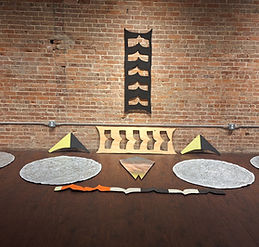

Mistakes, Misshapes, and Fakes
Ryan Akers (2023)
Artist Statement
With an interest in the emotive nature of shape, I use recycled textile felt to produce installation-based work. I create opportunities to engage with ambiguity through shapes that feel at once novel and familiar in order to allow space for embodied analog experience. I have developed an interest in incorporating observations I make while moving through the world into my work. These observations often serve as inspiration for the shapes, compositions, materials, and colors I use in my drawing practice. Recently, my practice has expanded into large-scale installations, which increasingly consider the architecture of the installation site.
Biography
Ryan Akers (b. Austin, TX) came of age in the American South. He currently lives and works in
San Antonio, TX. His work has been shown in solo and group exhibitions at The Burgin Center
for the Arts, The Robert Hillestad Textiles Gallery at the University of Nebraska in Lincoln, The
Montgomery Museum of Fine Art, and the Sella-Granata Art Gallery, with an upcoming solo
exhibition at The Gadsden Museum of Art. He received his MFA in painting and drawing from
The University of Alabama in 2023 where he was awarded multiple fellowships, scholarships,
and honors.


Abstract Art and How to Read It
(2023) Participating Artists: Robert Sturgis, Andrea Parham
ABSTRACT ART & HOW TO READ IT was curated by JSU Student, Nathan Young.
What is Abstract Art?
Abstract art uses visual elements like shape, color, form, line, and texture to create an image that is not naturalistically structured. There are numerous types of abstract art, but two of the major types are Cubism/Surrealism and Color Field.
How to View and Understand Abstract Art?
The main goal of abstract art is not to convey one specific thematic point but to promote individuality, creativity, and to evoke emotion. Instead of observing one specific part, this type of art is meant to be examined in its entirety.
Cubism and Surrealism:
Cubism and Surrealism first made their appearance in the early 1900s. Cubism is defined as bringing objects together in a painting in a way that makes them look fragmented. Pablo Picasso was the primary forerunner of the Cubist style.
Surrealism is defined by unique representations of life that are almost dreamlike. Salvador Dalí was the primary advocate for the Surrealist style. The two styles are connected because both offer a new interpretation of reality.
Color Field:
The color field art style emerged in the 1940s. This style is defined by flat colors covering much of the painting. The purpose is to focus on how colors make the individual feel rather than focusing on how colors create depth. Forerunners for this style include Frank Stella, Jack Roth, and Kenneth Noland.


Contemporary Feminism and Ekphrastic Art
(2023) Participating Artists: Alexa Lee, Cecily Downey, Derriann Pharr
Contemporary Feminist Art and Ekphrastic Poetry was curated by JSU Student, Abbie Tarvin.
What is Ekphrastic Poetry?
The term “ekphrastic” is a Greek word meaning description. An ekphrastic poem is a detailed description and interpretation of a piece of art, mostly paintings. Ekphrasis is specific to artworks and differs from its counterpart known as an after-poem. After-poems are a work inspired by literature or film.
How to Interpret Ekphrastic Poetry:
There are three elements to consider when interpreting an ekphrastic poem. These elements include the interpretation of the artwork, the perspective of the character(s) or speaker(s), and the background details.
Typically, these poems will include descriptive details about an element within the artwork, delivered through the perspective of the speaker. Ekphrastic poets will also often try to put the meaning of the artwork within the lines of poetry. The main point of these poems is to analyze and highlight the artwork itself.
Contemporary Feminist Art:
Feminist art has been prominent in our society since the late 1960s and is continuously evolving. The goal of feminist art has stayed the same—to highlight the differences and obstacles women face in society in hopes of gaining liberation and positive change.
Contemporary artists have transformed the way that feminist art is portrayed. Identity is now more fluid, and intersectional feminism has overtaken the “white feminist” narrative that used to dominate the movement.


For the Love of Dragons
Tod Grisby & Rhia Shae (2023)
Artist Statement
A Study of These Majestic, Mythical Creatures
This show was born of our shared love of fantasy art, in general, and dragons, in particular. We take our influence from fantasy greats such as Frank Frazetta, Boris Vallejo, Michael Whelan, Larry Elmore, and Keith Parkinson.
The characters depicted here are in development as part of some stories based on our world of Anhubioné. This fictional world was born during Rhia’s university years in the early 1990s. With a degree in geography, a love of cartography, and the enjoyment of playing Dungeons & Dragons with friends, the early stages of this world spawned.
Rhia's introduction to the fantasy genre was through the cover art on Anne McCaffery’s The White Dragon, and she fell in love with Michael Whelan’s artwork. Ms McCaffery’s Dragonriders of Pern books introduced her to dragons that were not treasure-coveting, village-burning, knight eating monsters but showed them as friends and protectors of humans. Rhia started drawing at an early age and fell in love with sculpture in middle school. Digital design and sculpting is a recent phenomenon in her life.
Tod's fascination with fantasy art started with a paperback copy of a Conan novel that he acquired at the inappropriate age of six years old. He was instantly fascinated by the cover art done by none other than the great Frank Frazetta. Tod drew in pencil and charcoal throughout high school but did not start to take art seriously until he left the Marine Corps in 1990. Shortly after that, he was gifted an airbrush. It was love at first stroke.
Though Tod’s art is strictly 2D and Rhia's is mostly 3D, there is quite a parallel in how we envision characters and enough difference to keep it interesting. Our collaborations are dynamic, with a free-flowing exchange of ideas and input on the designs – composition, color schemes, character personality, etc.
As artists, we document life. Be it everyday occurrences, a dramatic event, the beauty and ferocity of Nature, or the fantastic images our imaginations conjure.
We do so to invoke an emotional response from our audience. We strive to capture the essence of the moment and bring life and soul to a blank canvas or lump of clay, be it digital or physical clay. For artists, there is no greater joy than to see a viewer connect with their work, especially knowing that it is a personal experience for each viewer.
Our work is, of course, influenced by the art of our predecessors and our own personal experiences. Yet we strive to transcend that in a universal way.
As our body of work grows and we mature, we can look back into a chronological mirror of ourselves and go forward with the knowledge that our artwork will outlast us by decades for future viewers to reflect on and draw their own personal satisfaction or disdain.
From that comes the conclusion:
All we are is what we leave when we pass on.
From the Heart,
Tod Keith and Rhia Shae


How Do I Make a Painting
Ryan McRae (2023)


A Mortal Coil, The Duality of Life
Ruben Gaspar & Ana Mendoza (2023)
Since the age of five, Ruben Gaspar has had a love of drawing. As a young boy, he remembers asking his father to draw something for him. His father began drawing a depiction of a soldier, and as he watched, Gaspar found himself beginning to fall in love with the process. His admiration of his father’s appreciation of art has been his inspiration for his love of drawing today. He is continuing his pursuit of creative thinking as an engineering student at Jacksonville State University.


An Act of Attention
Molly Lay (2023)
My current work explores how the practice of walking through natural spaces can bring a sense of awareness to one’s lived experience. How might one still the mind by a simple act of attention beyond the self?


Tracing Shadows
Kole Nichols (2023)
This exhibition, titled Tracing Shadows, is a personal exploration of the physical, spiritual, and emotional. The work is often influenced by my interests in cyclical movements and patterns, navigation, mapping, repetition, light, presence, and absence. At times, there are references to architectural elements, organizational systems, and even natural phenomena. As I work, I seek to analyze and deconstruct moments or spaces that I encounter, hoping to create images and objects that embody their experience.


Spirits and Symbols
Hilary Blackwood (2023)
Artist Statement
Working with a variety of media including acrylic, ink, and pencil, Hilary creates work that is rooted in myth and the subconscious. Inspired by myths, illuminated manuscripts, and medieval art forms. Hilary uses geometric shapes and patterns to explore timelessness in art. Hilary often uses reclaimed and damaged materials to create art that is at once old and new. This process allows new works that evoke the past and the weathering of time and the meditative repetition of forms also allows for a flow state in which time seems to cease in existence; in essence, getting lost in the work.
In the works featuring figurative elements, Hilary explores twists on stories, myths, and the experiences of being human. The older stories and myths that inspired these works often tell us greater truths about ourselves and by reimagining these stories through painting allows for a greater understanding of the stories.
Art is timeless. The human drive to create is timeless. Anonymous works reach down through the ages but at some point, in the distant past, a hand created that work. It catches our eye and we wonder. The work you see here is following that long tradition of someone inspired to create and hopefully to cause someone to pause and look. And to wonder.


Y Not Love
Chris Washington (2023)
This movement is about unification through the visualization of art. Our world needs healing, instead of hate, instead of killing, instead of prejudice. Y-Not Love!

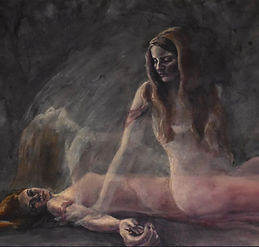

Alarum
Caylee Cooper (2023)
I question the definition in search for meaning. Terse, though I am, and utterly frightened of human contact and connection, therein lies my contradiction to seek it wholeheartedly: to achieve learning and understanding, to connect in response to our disconnection from the fear- based system we exist within.
Introductions, if I may... Fear, I know too well from our frequent conversations and debates... Steadfast friends one might say. It is through Fear, I met Perspective... Siblings possessing many a guise. Fear, I have determined, is a primal connector in Humanity, and Fear of Death, a profound, quiet link; I daresay an iron chain... Death, our ending... Death, a perspective of perception... Death, a fearsome, lurking mystery. While my own incognizance overwhelms me with terror, what beauty is ultimately beheld in my curiousities. I challenge the perception of such obsession through figurative personification, in charades of haunted imagery, visual narratives, and themes of mythos, occultism, religion, and symbolism. At what time do we
choose to be okay, as society defines it, with not being okay? When do we converse? When do we judge such action, and why? As seeker, catalyst, messenger, and painter, I challenge thee to pay heed to thy senses... breathe them in, listen, see, feel, taste, ponder... Allow thy senses to perceive the Alarum.

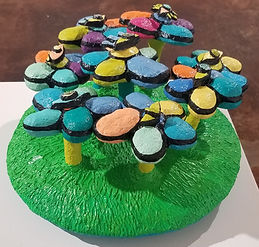

Uncoordinated Colors
Alex Dunn (2023)
Artist Statement
As a kid, I attended a performing arts school in Macon, Georgia, and from there, I knew art was going to be prominent in my life. I enjoyed sketching and painting, but I did not find my medium until 2 years ago when I started working with paper pulp. I chose to work with paper because I knew my first choice, clay, was costly. It took me a couple of tries to figure out the consistency, but once I got it right, I soon made my first piece "Alias Slyest Whims". Inspired by the vibrant hues of the 70s and 80s, I create colorful offbeat pieces merely because it brings me joy and keeps my mind wondering.


An Introduction
Aidan Garcia (2023)
Artist Statement
As an artist, I find solace in the transformative power of creativity. Through my artwork, I strive to capture the essence of my internal realm and translate it into visual narratives that resonate with others. With a palette of vibrant colors, I seek to evoke a sense of energy and vitality in my pieces, inviting the audience to explore the depths of their own psyche. Ultimately, my goal as an artist is to create a space for contemplation and connection, where art becomes a catalyst for personal growth and collective understanding.

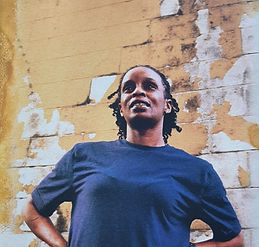

We Outside
Adrienne M. Reed (2023)
Artist Statement
“Stars when you shine, you know how I feel. Scent of the pine, you know how I feel. Oh, Freedom is mine, and I know how I feel.”
This is an active exercise in Freedom & Liberty outside of our concrete and pedestrian worlds. It’s an escape from the drudge of operating systems programmed to do only what we gotta do. It’s a celebration of having the luxury to do what feels good in lieu of only doing what must be done--Thriving in a world that’s working relentlessly to make it harder and harder for us to survive. Despite it all, in the midst of it all, We Outside.


Though Entry is Barred
Heather Baumbach & Tracy Hayes (2023)
Biography
Heather Baumbach's work is inspired by her community, her travels, and the beauty of everyday life. She enjoys working with her hands, creating works notable for their deft finish and tactile nature. Her visual art has been exhibited at The Broad Institute of MIT and Harvard, The Wiregrass Museum of Art, The Georgine Clark Alabama Artists Gallery, Lowe Mill Arts, and The Charles W. and Norma C. Carroll Gallery at Marshall University. In addition to art shows in Alabama, she has participated in juried festivals and exhibitions in Tennessee, Georgia, Kentucky, Florida, West Virginia, and Missouri. She also holds over 20 years of design and production experience in stage, television, and film, her credits including The Cherry Lane Theatre, The Theater Outlet, The Santa Fe Opera, The Los Angeles Opera, Maine State Music Theatre, Center Theatre Group, Carsey-Warner Productions, and Comedy Central. Heather holds a BFA in Costume Design from UNCSA and an MFA in Visual Art from Lesley University.
Tracy Hayes is a mixed media artist who has been showing since 2012. A native of Montreal who has lived in the US since attending University of NH (BA, French ’93), Hayes earned a BFA from NH Institute of Art ('12) and recently completed an MFA in Visual Art at Lesley University College of Art + Design ('21). Hayes lives and works in Morrisville, VT.
Artist Statement
Baumbach and Hayes combine their visual languages in a gestural interplay of their works for this initial installation. An extension of a shared interest in the embodied as guide to resultant imagery, dictated by the need of the body and of the hand, works emerge as lattice-like, structural, and above all, governed by an internal ordering logic. Lilting and intertwining, shapes expand and contract over and again as they seemingly gather strength from within and gain ground, tentatively at first and then with increasing speed.
Works like Baumbach’s Collapse and Hayes’ Obliteration Scrolls rise out of the depths, offshoots and offsprings expanding, gathering all surrounding in an effort to both assert presence and convey primacy. But there are coveted moments withheld, intimate pockets closely guarded from the viewer. Combined, the works of Baumbach and Hayes further blur the access points, complicated by the superimposed relationships of Baumbach’s forms to Hayes’ mark-making. One acts as protective armor while the other undergirds, the works coalesce and offer the viewer a new interpretation of interdependence - as akin to the relationship of skin and sinew to the vascular system.
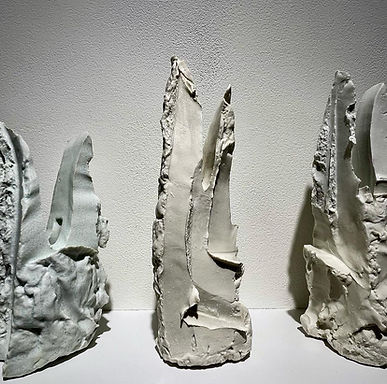


All That Remains
John Oles (2023)
As a maker of objects, Oles believes that truth and insight into our own human nature can be revealed to us through the practice and process of cheating with our hands. Oles believes in the power of the handmade object to communicate with people, on a subconscious level, the fragility and intimacy of the temporal moment. These contemplative objects reference the relationship of the body to landscape, both real and artificial, to create an environment for introspection. The intimate scale of these pieces invites you to be subconsciously familiar.
About The Exhibit
The pieces in this exhibition are touch stones to memories from Oles travels to Iceland, southern France, and Japan. Much of this work can be read as a Love Letter to porcelain and the way the material is able to so gracefully and willingly capture the slightest gesture or mark and create a record of that moment made permanent by the fire of kiln. Presented here is the synthesis of his early influences of Japanese tea ware, Chinese Song Dynasty porcelain, and the Sodeisha group of artists, along with his interest in contemporary design and Minimalism,
Although the ceramic language of glaze has been mostly eschewed, save for the juxtaposition if the occasional pale blue celadon, the kiln was fired carefully to produce the slightest variations of tone on the raw porcelain.
With visual noise removed, the interplay of Light and Shadow, Form and Memory are all that remain.


Convulsive Motion
Brandon C. Smith (2023)
Biography
Brandon C. SMith earned a Bachelors of Arts degree from Eastern Kentucky University (KY) in 2000, and a Master of Fine Arts degree from the University of Cincinnati (OH) in 2004. Smith has recently presented solo exhibitions at the University of Redlands (CA), Southern Oregon University (OR), Berea College (KY), Pittsburg State University (KS), Carnegie Visual and Performing Arts Center (KY), Tennessee Tech University (TN), Pedro Moncayo Foundation (Ibarra Ecuador) and most recently at the Heike Pickett Gallery (KY). Two person exhibitions include San Joaquin Delta College (CA), Perry Nicole Fine Art (TN) and Seminole Community College (FL). Smith has been included in group exhibitions at Heike Pickett Gallery (KY), Perry Nicole Fine Art (KY), Bennett St. Gallery (GA), Amy Baber Fine Art (LA) and most recently at The State University of New York in Brockport. Smith lives in Richmond KY where he works as a studio artist.
Artist Statement
In Mary Shelley’s Frankenstein, when the monster stirs to life for the first time, the book says there is a “convulsive motion” in the limbs. Invoking something like a newborn animal scrambling clumsily and desperately to stand, or arms reaching after long sleep with tingling fingers too weak to pull ones weight forward.
The limbs hang and dangle. Lines describe what is there and what is not there. The carved dark shapes, the backs of a hands and elbows are solidly described against a field of smoky neutral pale light. The lines arc toward the lurching bodies to lift or impede the weight. Figures are composed of mismatched proportions, hewn at the joints with fragile red lines. Identity is obscured in thickets of opaque dark masses. In the vague expressive dust of soot and pigment rests forms uneasy in their shape, ungainly and uncomfortable. The blue washes over them, or suspends them in time. They sit, they yell in puddles of pink, wade through streams of viscous red, and troweled on blacks and brown. Trapped in vague spaces of strokes and marks they reach, wobble and try to stand. They are dark and emotional, sentimental even and sometimes wretched in their form. They pay homage to the truth but only fleetingly and uneven. In the spaces between truth and visual chaos, they are both beautiful and grotesque.
WWW.BRANDONCSMITH.COM

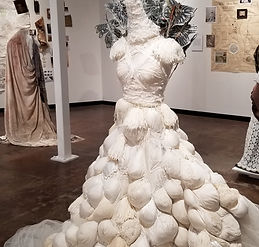
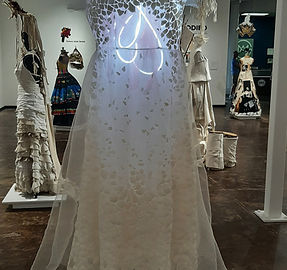
Embodied: Contemporary Takes on the Dress
(2023) Participating Artists: Merrilee Challiss, Leanna Leithauser Lesley, Alvina Zendejas Montes Hill, Tara Stallworth Lee, Michelle Reynolds, Tracie Noles-Ross, Cynthia Wagner, Erin London, Katie D'Arienzo, Chiharu Takashi Roach, Amanda Banks, Kimberly Hart, Sarah Jane Shaw
EXHIBIT ON VIEW FROM
JUNE 2 - JULY 27 2023
READ MORE: https://www.gadsdenmuseum.com/embodied
Embodied: Contemporary Takes on the Dress
Born out of the desire to add a sculptural element to an existing solo show, this exhibition came together organically at the onset of a worldwide pandemic and lockdown. Touching base with colleagues in the early days of a new reality, gave clarity to a collective inclination to create dresses for the purpose of telling personal stories.
Nine artists, working respectively on each piece and communally toward the greater exhibition, created an immersive study into individuality, semiotics, joy, sorrow, and humanity. Each dress is a visual narrative drawing from observation and experience. The hope, as you reflect on this retrospective, is that you find a piece of yourself in one or more of these dresses.
LEANNA LEITHAUSER LESLEY
Artwork: Black and Tan Fantasy
For four years, Duke Ellington and his orchestra played on the veranda of an Old South set in the famed wealthy “whites only” Cotton Club. The plantation theme played out in actuality every evening with the club’s strict segregation policy as Ellington tirelessly wrote scores to be performed nightly by his orchestra and the club's exclusive ‘Tall, Tan and Terrific” dancers. Racial abuse and exploitation were forms of direct discrimination for every performer at the Cotton Club.
Simultaneously, Ellington quietly devoted his services to the NAACP and its racial equality activities, while using his national exposure via the Cotton Club radio show to elevate the perception of the culture behind jazz music. His battle for social justice was personal. That same year, he wrote his famous Black and Tan Fantasy score which completely challenged what was then called jungle music with a sophisticated fullness of heart and heaviness of mind, giving the piece its beauty. By using African American blues-based expressions, he hints at the unsettled state of the human soul.
Ellington’s music, which appealed to Blacks and Whites alike, provided a culture in which the collective and the individual were inextricable.
“Jazz is the only unhampered, unhindered expression of complete freedom yet produced in this country.” - Duke Ellington
This piece is a freehand needle pointed, free motion stitched, and hand sewn commentary. The beauty of the Art Deco movement and the 1920s Harlem jazz music scene is set against a backdrop of race riots, prohibition, mobsters, and exploitation. The symbolic use of safety pins is my desire to protect and secure these jazz paragons from the harm inflicted by the very people who cashed in on them.
SARAH JANE SHAW
Artwork: Certain Decay
"Work in this project began in the spring of 2020. Hampered by the state of the world, and only able to create using what was at hand, I found the overgrown, hidden trail behind my home an endless supply of materials which fed my imagination. Using a well loved dress form from the 1930's era as the foundation, I began creating a garment from the items I found on my concrete trail.
Gradually adding other treasures including porcelain doll parts scavenged from the estate of a doll maker and twisted branches gathered after heavy storms, lead me to the idea of combining the decidedly human-made dolls with an overgrowth of the natural world. Additionally, the viewer is presented a sense of dark whimsy reminiscent of the haunted house in a child's story.
Much like the ecosystem of a tide pool or the micro worlds of forest moss, this piece is home to various creatures and their secrets. The viewer is invited to gaze with childlike curiosity and wonder as the dress aims to capture and show a slow, quiet magic - the same magic that allows a tree to recognize her daughters through the mycelial web in fungi's placement at both the beginning and end of a life cycle.
This dress speaks to an eerie comfort found in the certainty of decay and the inherent regrowth which follows. Going forward, this piece will be included in a greater "Mother Nature" series highlighting the divine feminine."
ALVINA ZENDEJAS MONTES HILL
Artwork: Gown Alvina
Hola, mi nombre es Ma. Alvina Zendejas Montes Hill, me hace ilusión participar en el diseño de vestidos para este evento. Al diseñar este vestido, me inspiré en México, que es mi país natal. La tradición textil tradicional es muy extensa, colorida y utiliza diversos materiales para formar una prenda. El vestido que he creado, tiene bordados a mano, estampados de pintura, y es un vestido largo. He utilizado los colores azul, negro, dorado y ocre, en telas de algodón, en la forma. Mi idea pero siempre la realidad, juego con las combinaciones y quizás al final acaben en otra afinidad, ya que la creatividad siempre sale de mi mente con soltura.
Hello, My name is Ma. Alvina Zendejas Hill, I am excited to participate in the design of dresses for this event. When designing this dress, I was inspired by Mexico, which is my favorite country. The traditional textile tradition is very extensive, colorful and uses various materials to form a garment. The dress that I have created, has hand embroidery, paint prints, and is a long dress. I have used the color blue, black, gold and ochre, in cotton fabrics, in the form. My idea but always reality, I play with the combinations and maybe in the end they end up in another affinity, since creativity always comes out of my mind with ease.
MICHELLE REYNOLDS
Artwork: Interconnected: Remnants of Cloth and Nature
My dress symbolizes both loss and a sense of hope in an age of environmental disregard. I have a desire to retreat into a garden and go on lone excursions, finding nature vignettes wherever I go. Communing with nature reveals the complexities of relationships - between creatures and habitats, plants and animals, man and nature - I'm always seeking to understand and find my place in nature's web.
Reality meets mythological and biblical. Snakes are woven into the themes as symbols of health, regeneration and renewal. Slithering through the scene, they become beacons of hope and wishful thinking as I ponder the perils of the earth. I long to mend the wounds, nurture connections to the natural world, and foster conservation ethics.
The assemblage of remnants and threads helps tell a cautionary tale. Machine sewn and hand stitched, stored wall and staffs are pieced and patched, and sutured with stitches of heavy string to symbolize interconnections in nature. Even though connections in nature have been forged over long periods of time, the processes are ongoing. Life is fragile. Natural systems and the ties that bind can unravel in moments.
Humans have drastically changed the Garden of Eden. Climate change, pollution, and degraded ecosystems are a few of the perils caused by their sins. The warnings and wisdom from scientists go ignored as the symbols of health and spirit look on. I hope for a new age of enlightenment. I am ready for mankind to take responsibility, slow the trajectory of destruction, and suture and stitch the wounds of the Earth.
ERIN LONDON
Sometimes profound moments come from the mundane, like finding wisdom in a line spoken on Buffy the Vampire Slayer. I look to bring the power of story to discarded items, weaving nostalgia and personal symbolism into pieces. I address womanhood, domestication, tradition, and consumerism using a patchwork quilt approach - various mediums and moments from life brought together to make something new. I find patterns in process and meaning while trying to resolve my experience as well as relating to the common experience. My practice often involves collaboration, which speaks to the female experience of being smaller-than/ less-than and requiring the approval of others to be heard.
Starting with a bed skirt, a shower curtain, and some towels, I made a dress that challenges the lack of sustainability of the wedding dress. Instead of being worn only once, as is often the case with cheap, fast-fashion items, this dress would travel the world with a message to the fashion industry: a message of body exclusivity, addressing the lack of diverse women in fashion advertising. The dress’s construction was intentionally designed to adjust to a range of sizes and body shapes and has traveled to Alabama, California, Illinois, Maine, Pennsylvania, and Tennessee, as well as Canada, England, France, Iceland, and Scotland. What began as a project on fashion sustainability morphed into a lesson on complex questions, hard answers, and finding my voice.
CHIHARU TAKAHASHI ROACH
ローチ 髙橋 千春
Artwork: 神隠し: Kamikakushi
神隠しとは、人間がある日忽然と消え去る現象で、日本では古くから神の仕業又は怪の仕業で現世から結 界を越えて神域に消えたと考えられています。 私には幾つか歳上の兄弟のいとこがいました。二人とも大変明るく元気な男の子で、子供の頃はよく外で 暗くなるまで一緒に遊んでもらいました。しかし兄の基は高校から規律の厳しい全寮制の学校に入学し、そこで 対人恐怖症を患い、全くの別人に変わり果て引き篭もりになってしまいました。弟の晃は健康だったのにもかか わらず、仕事の過労からくる心臓発作で突然死し、一人暮らしのアパートで数日後発見されました。二人とも神 隠しにあったかの様に現代日本が抱える社会問題(社会的参加を回避する”引き篭もり”、ブラック企業による過 酷な労働からの”過労死”)に押し潰されて私の人生から突然いなくなってしまいました。 このドレスは長年にわたり厳格かつ完全主義を求める日本文化の歪みに心が砕け、自分を見失い、抜け殻 にされた数えきれない人達の魂と私のいとこへの想いを表現しました。日本の象徴である紅白を基調とし、もう 自らの言葉で語るこのできない彼らの精神を人形として形にしました。英語では”神隠し”を”spirited away” と翻 訳されます。私は今も彼らとの楽しかった時間を胸に、彼らの消えた魂を想い、切なく物悲しい気持ちになるの です。
“Kamikakushi” means to mysteriously disappear without a trace. According to traditional Japanese folklore, people have believed that gods or the “Kai” (like Mononoke, who is a supernatural being) takes humans to another world from this world. I had cousins who were brothers that were a couple of years older than me. They were very cheerful and bright boys. As children, we always played outside together, well after dark. After the older brother, Hajime, entered a boarding school that was very famous for being intense and strict, he developed anthropophobia, a fear of people. He is no longer the same person that I knew as a child and he has not been able to leave his room for over 40 years. The younger brother, Akira, who was a very healthy person, had a stroke and was found dead at his apartment several days later. It was death from overwork. Rigid social norms and high cultural expectations in Japanese society can often create feelings of inadequacy. These feelings can trigger socially avoidant behaviors sometimes known as “hikikomori”, a form of social withdrawal. Both of my cousins disappeared suddenly from my life as “Kamikakushi” because of modern Japanese social problems. This dress represents my cousins and countless other Japanese citizens who have disappeared or "spirited away" throughout decades of cultural rigidity and a callous expectation of perfectionism. The red and white colors refer to the flag of Japan and the dolls honor those souls who can no longer speak for themselves. "Kamkakushi" is translated as "spirited away" in English. I have beautiful, sweet memories of my cousins and I miss their souls with a painful melancholy.
- Translated by Tracie Noles-Ross
AMANDA BANKS
Artwork: Alvitr (Strange Creature)
Alvitr (Strange Creature) is a layered A-line gown that tells the story of a contemporary valkyrie through modular garments and found objects. The bodice is comprised of a flurry of crocheted cotton snowflakes that swirl around the torso and down the arms, wrapped in a translucent outer layer of vintage metallic fabric. A length of embellished spandex wraps delicately around the hips, revealing additional layers of faux fur, recycled lace, and rose-embossed velvet draped dramatically to the floor. A belt of hand-painted leather sits at the waist, fastened with an assembled medal rosette and holding trophies collected over a lifetime.
The accompanying headdress is made of crocheted cotton, steel, and found objects. This work was inspired by rediscovering childhood ice-skating memorabilia during a personally difficult season. Finding my old ice-skating awards opened long-dormant wounds left by a traumatic past. Creating Alvitr presented an opportunity to shift the narrative around those past events into one of empowerment. This gown embodies the spirit of people who teach others how to embrace all of their intersecting layers, create beauty from chaos, and bravely challenge oppression.
I used a variety of interesting materials to create Alvitr. My process emerged through intense research, experimentation, and playful exploration of crochet techniques I have known since childhood. Many of the early decisions for this work were made to explore and challenge the physical limitations I experienced during my recovery from trauma. Each component marks a personal milestone in my recovery and a new horizon to explore in future work.
KIMBERLY HART
Artwork: sky blue gown
silk
potassium ferricyanide
ferric ammonium citrate
sunshine
sunshine
sunshine
h2o
where do I fit in this blueprint of time and genes?
look at me! see me!
my grandmother's melancholy and anxiety
my grandfather's anger and rage
my father's temper and his toes
my mother’s bent her pinky fingers and harsh words
my brother's wobbly reality of here not here
my aunt's squinty left eye with squeaky Tourette’s
look closer
the generations rolled into me
DNA or epigenetic
breathe: one, two, three four; one, two, three four; one, two, three four
the mean voice of shame and difference.
little one, sit with me
listen the wind in trees and feel it in your hair
come into the cave and sit with me
have a cup of tea and a nap
let go: breathe
onetwothreefour
olly olly oxen free
compassion and kindness disrupt the pattern
mother, mother, father, father
where does it end!
onetwothreefour
olly olly oxen free
KATIE D'ARIENZO
Artwork: My Kimono
Moving to Huntsville, Alabama from Honolulu, Hawaii as a small child proved to be a pivotal event in my life. The struggle with feeling like an outsider due to my Japanese heritage has formed my journey to adulthood. The conversations and comments made regarding my Japanese features, family traditions and stereotypes left me battling self-consciousness and as a young girl, I felt set apart. Embracing heritage in a place that feels so far removed from my roots has given me the courage to accept myself.
The kimono is a symbol of longevity and good fortune. Using cyanotype printing which creates an ultraviolet and blue light spectrum, I have infused each panel with a part of myself. In Japanese culture, the color blue symbolizes dignity and stability, something I have spent a lifetime searching for. This blue garment is a collage of places and things, from my Japanese ancestry to early adulthood in Alabama. Each panel is a part of who I am.
TRACIE NOLES-ROSS
Artwork: Widow’s Weeds
I began the process of creating a dress for this show by exploring the history of mourning attire because I am newly widowed. I glommed onto and immediately started riffing on the term “widow’s weeds”, a term used, primarily in the Victorian age to describe mourning clothes of a widow, because of that weird word weeds. In the context of this term, weeds comes from the Old English word "Waed" meaning "garment" but I cannot help but think of the definition of the word that refers to a plant, specifically an unwanted plant. It is an unfortunate but interesting coincidence since widowed and older women in general are often perceived and treated as unwanted, under-appreciated and invisible members of society.
In keeping with the unwanted plant metaphor, I have employed nature motifs and plant dyed and repurposed (tossed and worn out) fabrics to create a piece that represents a period of change, the time of menopausal shift and the metamorphosis from married family woman to the solitary elder wise women. By exploring the female elder archetypes, I have created a metaphorical garment representing the wise old healer, the seer, the earthy witch in the woods of fairy tales, the holder of stories and the knowledge of the mysteries of woman. I have created a dress that is evocative of the forest floor, a place where death, regeneration and new life coexist in a beautiful subtle mutualism and layered that with anatomical representations of parts of a woman’s body.
CYNTHIA WAGNER
Artwork: The Communists are Coming for Us
The creation of this dress provided me with an opportunity to poke around in my soul and personal history looking for answers, clarity, and some healing of the childhood trauma I endured at the hands of my mother. Mom had childhood trauma of her own and serious mental health issues. She struggled to keep above the fear, depression, and the overwhelm of her eight children, my father’s working-class paycheck, her mid-century idealism, and the weight of her religious and political extreme conservativism. I never knew when the ground under my feet would give way and Mom and her world would come crashing down around me, literally. This led me to be hyper vigilant, watching for danger to appear at any time and so I managed by learning to “walk on eggshells”.
Another thing that got me through such a challenging childhood was some of the supporting people in my life including my paternal grandparents, a few teachers, and some of my close friends and their parents. I’ve found myself collecting one of the primary materials of the dress – eggshells – from friends and family because it’s taken such a surprising number of eggshells to make the piece. It’s hard to imagine making it through all the challenges of life without the help of others. Thanks to those who’ve helped along the way to smooth off the edges of my fears and make the world a more comfortable, supportive, and creative place to live.
MERRILEE CHALLISS
Artwork: “Chrysalis” S(mother) S(moth)er
“Chrysalis” began in 1999, first as a quilt project for an installation. “S(mother),” the original name for the project, was created over six months of hand-sewing separated bra cups that had been stuffed and rejoined, creating an undulating sea of mammary glands. Underneath the quilt was sewn a layer of red silk, edged with layers of tulle. “S(mother)” was an investigation, inquiry, and critique of the maternal, and our ideas of femininity, mending, and motherhood. Under the umbrella of “domestic conceptualism,” a term which I coined at the time to describe the intersection of art and craft, “women’s work,” fabric functions as skin and stitches suggest surgery and sutures (alluding to Amazonian warrior goddesses, breast surgeries, etc.). As my work centers around themes of transformation, identity, and consciousness, I often cannibalize my own work as I, myself, evolve, transforming and evolving individual pieces by other means of production, sometimes working on and transforming materials for years. ”S(mother)” transitioned to “Chrysalis,” from a quilt to a sculpture, through the process of attaching it to a dress form cocooned in fibers, in the 2010s. Offering alternative multi-valent readings of the materials and layers as a site of transformation, evolution, and mutation, “Chrysalis” continues to situate itself in liminal territory. Between the sacred and profane, between purity and putrefaction, where the growths and presence of the moths project more a “Ms. Havisham” than a wedding vibe, “Chrysalis” projects an emergent shadow of the dark feminine within.
TARA STALLWORTH LEE
Artwork: Trees Love Us
ITERATION 1
In the winter of 2018, I made a paper dress from a pile of handmade abaca sheets. I used a childlike mindset, scissors, glue, and thread to fashion a simple A-line form. That same year, as a featured artist for a fellow artist’s photo project, I posed in front of a discarded bed sheet while wearing my paper dress. Titled, I Am Not Your Mother, it was also included in the 2018 exhibition, Paper/work, hosted by Alabama Women's Caucus for Art. In 2021, I layered, along with the dress, rust-soaked paper towels, organic matter, and tiny rusty things, then rolled the concoction around a rusty pipe and eco-dyed the bundle. It fell apart at the seams and was more beautiful than before.
ITERATION 2+
Philosophies of the Jedi inform the gown, as do converging messages of Princess Mononoke and monkhood. Themes of spirituality, nature, tradition, and progress are ever-present. This triple robe set design is borrowed from traditional monastic dress. It’s made from “pure (unwanted) cloth” and incorporates the aforementioned rejected bed sheet. The repurposed pieces were soaked in an ever-changing dye bath of rusty materials and other organic matter, exposed to sun, wind, rain, and the occasional hail or snow, returned to the bath, then the elements again, back and forth in an irregular rotation of saturation, bleaching, and decay. Cyanotype chemistry was later added, and my grandmother’s threads, accumulated buttons, and little objects adorn the set. It is draped on, over, and around a plaster cast of my torso that’s been strengthened with layers of the original paper dress, unfolded paper cranes, and my children’s elementary schoolwork.
"Not everyone is naturally talented at sewing, and making your first triple robe set can be frustrating, However, this kind of frustration can teach us how to start truly letting go. The qualities needed for a life of meditation and renunciation – resourcefulness, steadfastness, and a willingness to not give up when things get difficult – are all introduced through sewing robes. Then, when the robes are finished, we look after them well because we understand the effort that went into them." – Ajan Ñaniko


Natural Intersections
Wanda Sullivan (2023)
Sullivan's work is conceptually based on the intersection of the natural world, her personal gardens, and the effects of climate change. She takes photographs of flowers and ginkgo leaves and with various apps on her iPad, she alters the images. Through this lens of technology, Sullivan mimics what is essentially taking place in our world.
About The Exhibit
Sullivan contrasts the measured symmetry, and recently, deconstructed layers of her computer-assisted designs with painterly, atmospheric layers of paint. She reveals in color, undulating form, and alluring textures. She celebrates the paint and tangible aspects of color. Her flowers are beautiful, but they are monsters, contemporary, biomorphic Frankensteins. They are designed to seduce the viewer and lure them in, just like our dependency on fossil fuels, phones, tablets, and computers do. They are intended to be like snares. Just like the climate crisis, they do not look dangerous because they are beautiful.
That's part of the problem Sullivan believes, that we cannot see climate change. The landscape is still beautiful, her yard is lush and dripping with Spanish moss, just like her work at home, the campus of Spring Hill College. The view out of her window at work is like a postcard. Everything looks beautiful, just like it always has, but it's different now, it's scary.
We only pay attention when the house is on fire. She obsessively paints her monster flowers and hope, hope for change, hope for solutions. Hope for everyone's children. Her paintings are her primordial silent scream.


Rebuilding
Alex McClurg (2023)
Biography
McClurg's work is informed by his attraction to geometric illustrations from book covers created in the 1960s and 1970s, quilt patterns, and the idea of displacement. I continually question my compositions as I strive for simplicity. The patterns are intuitive and are generated at the moment, similar to the traditional way of designing a quilt. Creating these patterns becomes a meditative process. Areas of the paintings show shapes in positive and negative forms. Certain shapes and lines are off-kilter and seem to be moved from their original location or expanding off the surface. These paintings are my attempt to show tradition combined with the moment of displacement.
Artist Statement
My work is informed by my attraction to geometric illustrations from book covers
created in the 1960s and 1970s, quilt patterns and the idea of displacement. I
continually question my compositions as I strive for simplicity. The patterns are intuitive
and are generated in the moment, similar to the traditional way of designing a quilt.
Creating these patterns becomes a meditative process. Areas of the paintings show
shapes in positive and negative form. Certain shapes and lines are off-kilter and seem
to be moved from their original location or expanding off the surface. These paintings
are my attempt to show tradition combined with the moment of displacement.


Naturphilia
(2023) Participating Artists: Allison McElroy, Lisa Schonberg, Marte Kiessling, Mike Clemow, Stig Marlon Weston
Jacksonville State University
Art Department Head,
Bryce Lafferty
Allison McElroy, Professor of Painting at Jacksonville State University organized Naturphilia, the first artist residency sponsored by the Gadsden Museum of Art, the Little River Canyon Center, and JSU. Allison, through this residency, brings four international artists to North Alabama to share their unique perspectives. Like Allison’s art, the residency explores associations with nature-materials – items as elemental as sound, light, and the very ground beneath our feet. As North Alabama community members, the artists in this residency offer us the exciting gift of seeing our surroundings in a new way as we witness how they filter their experience of our region through their own artistic sensibilities.
Biography:
(Allison McElroy) Artist Educator interested in using nature as an artistic medium that will decompose and decay over time. We live in a world full of objects so I am somewhat burdened by creating more objects. We are born, we live, we die, we decay. Studying the process of natural materials is a replica of the human. Make, create, recycle, reuse, art that will compost itself and decay to help the environment when finished. Pigments are collected on hikes and made into oil paint and water color paint.
www.allisonmcelroy.com
Lisa Schonberg
Troy, NY
Sonic Therapies for Toxic Relations: (1) [Bio]Plastic music (2) HVAC (3) Treehoppers
medium/format: 4-channel audio
Sonic Therapies for Toxic Relationships are 3 music compositions that invite re-consideration and re-configuration of individual behavioral patterns through exposure and immersion. The addition of percussion and electronic instrumentation to soundscape compositions of insects, anthrophony, and plastics presents possibilities for moving beyond anxiety and avoidance, and towards intentional exchange. The works include, rather than hide, human-made sound (anthrophony) to encourage listeners to consider humans as actively engaged, rather than as controllers or spectators.
Extended Descriptions of each work:
Bio(Plastic) Sound features petroleum and plant-based plastics juxtaposed with sounds of the Rio Chagres, in Panama, which was dammed in 1904 to create the Panama Canal. Sounds of boats and riverine non-humans are difficult to distinguish from the plastic, mirroring the emergent ecology of the Canal, engineered by humans, polluted by plastic, and inhabited by infinite unknown sound-makers.
HVAC (2022, 4:45, vocals by Jane Paik) HVAC features sounds recorded from inside the nests of leafcutter ants (Acromyrmex sp.) on the UFAM campus in Manaus, Brazil: stridulation and locomotion produced by the ants, and the sound of air conditioning systems of nearby buildings. Percussion and vocal improv mimic and respond to these field recordings. Spatialization of the arrangement is abstracted, a speculation on what an ants’ sensory experience might feel like, since we cannot
truly know.
Treehoppers (2022, 4:30, with recordings by Rex Cocroft) Treehoppers communicate with substrate-borne vibrations through plants. They are social creatures. They sound a bit like whales.
Many species resemble small thorns.
Text Scores for Getting to Know the Invertebrates
medium/format: printed text ( 7 prints, 8.5 x 11 each, mounted on wall), plus 1-2 copies of the print publication of the book on a plinth or music stand next to prints
Text Scores for Getting to Know the Invertebrates is a collection of creative scores that invite reconsideration of individual relations with insects (and more broadly, invertebrates) through prompts that guide interactions with them. These scores are inspired by composer Pauline Oliveros’ writing and scores, in which she challenges performers to listen as intently to sound as they possibly can – pursuing “perception at the edge of the new.” These scores do not require you to make music out loud, but rather prompt you to auralize – a term that Oliveros coined to mean listening or making sound in your mind. A QR code is provided so that you can access these scores and follow them after leaving the exhibit.
Biography
Lisa Schonberg is a composer and percussionist creating sound works based in ecological research. Informed by her background in entomology, Schonberg is interested how these sound works can reveal and challenge assumptions about insects and other overlooked and/or avoided nonhumans. How can insect agency be revealed through listening? Since 2017 she has been collaborating with Brazilian entomologists on ATTA (Amplifying the Tropical Ants), a project investigating ant bioacoustics in the Amazon. Other recent work includes investigations of old-growth forests in Oregon, endangered Hawaiian Hylaeus bees, mushrooms, and plastics. Schonberg's compositions are performed by percussion ensembles Secret Drum Band, Antenna and UAU. She is the author of Text Scores for Getting to Know the Invertebrates, The Hylaeus Project, and the The DIY Guide to Drums, and has presented work at FILE Festival, The Pompidou, Brooklyn Museum, Bosque da Ciencia (BR), American Museum of Natural History, and Museo Reina Sofia (SP). She has completed residencies with Labverde, the Banff Centre, Pioneer works, HJ Andrews Experimental Station, and Signal Fire. Her work has been supported by the Oregon Arts Commission, Regional Arts and Culture Commission (OR), & The Andy Warhol Foundation for the Visual Arts.
www.lisaschonberg.com
Stig Marlon Weston
Oslo, Norway
Performance Prints #1 - We can feel the sun
medium/format: photographic lumen prints made during group performance
A set of prints made by the participants during a group performance exercise. Instructions for a shared group experience are given to the participants, together with the materials to document it. The participants use the photographic material as instructed to create an imprint from their activity. The prints are then exhibited later as proof of the experience.
Biography
Stig Marlon Weston uses photography to explore different ways of seeing and understanding the world. By utilizing cameraless techniques to capture images of interactions he looks at how a collaborative approach to imagemaking can give us an imprint of shared experiences. Weston works as a photographer and independent artist in Norway. He runs a community darkroom and studio collective as a platform to curate and organize events and exhibitions. His work has been exhibited in national and international festivals and exhibitions and is in the collection of the Norwegian National Museum of Photography.
http://www.weston.no/
Marte Kiessling
Berlin, Germany
Paradise Lost - The edition of wishes
medium/format: Experimental film
At the core of all artistic work is the desire to experience, to be excited, to discover and to share. This is why the LABVERDE program, with its international focus, invites artists to the Amazon region to engage in an in-depth exchange with scientists working in the fields of biology, ecology, and sociology, as well as with local people. Marte Kiessling received a scholarship in the year 2018 and conducted research on site on the subject of “Paradise Lost”. For Marte Kiessling, first hand experience of the Brazilian rainforest prompted her to go far beyond specific ecological or social problems to explore a much more fundamental issue. “What does paradise mean to you?” she asked a broad range of people she met during her stay in the Amazon. The highly personal answers she received run the gamut from dismissing the concept of paradise as a means to manipulate the masses, to understanding paradise as a state of mind, to depicting spiritual images of nature and imagining social utopias, to a simple snapshot of a cherished act and the joy it brings. Kiessling overlays the interviews onto images of the Brazilian rainforest that range from sweeping vistas over water and dense forest to close-up shots of ants, creating a vivid overall picture. (Katharina Maria Raab)
Growth (Flowers)
Video installation - room opposite
It is inevitable for human survival to utilize artificial resources. In nature, the race for survival usually ends deadly. Everywhere, where a living being is unable to run away fast enough by it’s own means, it will be eaten. Humanity managed to free itself artificially from this original state by fighting against it wilfully: By using superior weapons and technologies, shelters and all the other, nature-protruding, artificial conditions. But: how long may the meaning of “artificial” be considered as the good old “imitation of a natural model”? (Excerpt from: Die Zeit, „Die künstliche Natur“ (the artifical nature) by Nom de Net, 2011)
Robots instead of real animals, a video-fireplace instead of a real fire: Humans increasingly consider the technical reproduction of nature more real than nature itself, as American scientists recently detected. This could lead to the fact that humans lose the perception of real nature along the way, as scientists recently wrote in the scientific journal “Current Directions in Psychological Science“. Thus, humans would numb themselves to the increasing overexploitation of nature. Besides, artificial nature has a less relaxing effect on people who have knowledge of the real one. (Excerpt from: Wissenschaft aktuell, „Künstliche Natur lässt den Menschen zunehmend abstumpfen“ (Artificial nature increasingly numbs humans) by Doris Marszk, 2009)
The contrast between artificial nature versus real relaxation-space forms the base for the series of projections titled »Growth - Flowers«. Modern humans of the western world like to build virtual worlds, artificial nature, plants as decoration or simply an artificial quiet space, instead of viewing REAL nature, the dwindling one, threatened by climate change, as the base for their own peace and quiet.
Biography
Marte Kiessling, originally from the south of Germany, studied fine arts at the Hamburg University of Fine Arts and the Iceland University of the Arts in Reykjavik from 2001-2007. An important part of her artistic practice consists of collaborations, for example, she worked with the artist groups Cameracartell in Hamburg and Global Alien in Berlin, was a member of Hinterconti e.V. in Hamburg, and regularly curates exhibitions in Germany and abroad. Her work is shown internationally, for example at Goethe Institute Montreal, Kunsthalle Exnergasse in Vienna, Kunstverein Hannover, Kunsthaus and Kunstverein in Hamburg, galleryHOMELAND in Portland/Oregon, Schuckert Höfe and Funkhaus in Berlin, Emily Harvey Foundation in New York, Kunsthalle Wilhelmshaven, Galerie Meyer in Marseilles and many other places. Through an intensive examination of the medium of video art, she regularly takes part in screenings and film festivals, including Kino der Kunst in Munich and the short film festival in Hamburg. Her projects and travels have already been funded several times by the Berlin Senate and the Institute for Foreign Relations. Since 2007 she has also received several grants for artist residencies in Iceland, Finland, Sweden, and Norway as well as in Austria, Italy, France, Canada, Brazil, and Japan or the Schleswig-Holstein Artists’ House in Eckernförde. In 2009 she received the Goldrausch scholarship in Berlin. Marte Kiessling is a member of the SALOON network in Berlin.
www.martekiessling.de
Mike Clemow
Brooklyn, NY
Bill of Lading (Gadsden, Alabama), 2023
medium/format: Processed field recordings, voice, documents
“Bill of Lading” consists of a list of visual and sonic “images” that have been extracted from Amazonia as a result of the artist’s process of making field recordings and photography. Each time the work is shown, the artist documents its importation to that gallery or museum, providing all the necessary translations or transformations, and requires a receipt from the gallery as documentation of carriage and receipt of these items, which will be included in the next showing. Thus the work accumulates documentation tracing these materials from Amazonia to their current location via the acknowledgement of previous institutions in which it has been displayed. There is a stipulation that the work cannot be shown in two places at once, as it is only complete with the documentation of its previous location. This will be the fifth importation/exhibition of the work.
www.michaelclemow.com
Twenty-Three Objects Found On The Road In Limpopo, 2018
medium/format: Unmarked cassette tapes, cassette player, table, chair
“Twenty-Three Objects Found On The Road In Limpopo” is a collection of recordings made using found objects picked up by the artist during a wildlife field recording trip to the Limpopo region of South Africa in 2015. As the objects are inanimate, the sounds recorded are made through their handling in front of the microphones. The recording of each object is printed to a single, unmarked cassette tape. Visitors are invited to select one or more tapes and play them using the provided cassette player. There are no images or descriptions of the objects.

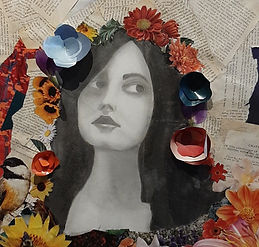
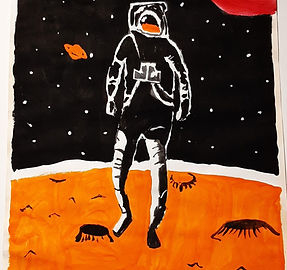
GMA Children's Show
GMA Children’s Show (2023)
2023 Student Show Winners
Kindergarten
1st place – Liam Holderfield/GCSA
2nd place – Madelyn Leonardi/Eura Brown
3rd place – Savannah Ballog/Westbrook
Honorable Mention – Wyatt Gilmer/GCSA
Honorable Mention – Taylor Fuller/Westbrook
1st Grade
1st place – Jackson Ray/Westbrook
2nd place – Jonna Bishop/Carlisle
3rd place – Jayonna Brooks/Striplin
Honorable Mention – Zoey Fuller/Westbrook
Honorable Mention – Harlee Stracener/Carlisle
2nd Grade
1st place – Kian Barnes/Striplin
2nd place – Emment Gulledge/GCSA
3rd place – Parks Garner/Westbrook
Honorable Mention – Wes Hall/Eura Brown
Honorable Mention – Ellie Jones /Westbrook
Honorable Mention – Avery Dingus/GCSA
3rd Grade
1st place – Caroline Millican/Carlisle
2nd place – Ava Aguirre/Striplin
3rd place – Mollie Collum /Carlisle
Honorable Mention – Layla Brown/Westbrook
Honorable Mention – Za’Leria Young/Adams
Honorable Mention – Abby Sullivan/St. James
4th Grade
1st place – Reid Harbison/GCSA
2nd place – Zaela Gibbs/Carlisle
3rd place – Evelyn Wilson/GCSA
Honorable Mention – Mary Francis Walker/Eura Brown
Honorable Mention – Jayla Glass/Thompson
5th Grade
1st place – John Burns/GCSA
2nd place – Jenna Hughes/GCSA
3rd place – Jenna Hughes/GCSA
Honorable Mention – John Wesley Legg/WCS
Honorable Mention – Mary Kate Millican/Carlisle
Honorable Mention – Brycelyn Blackmon/Carlisle
6th Grade
1st place – Lauren Anthony/WCS
2nd place – Claire Wilson/GCSA
3rd place – Jessai Lopez/Litchfield
Honorable Mention – Nisakon PongPang/Emma Sansom
Honorable Mention – Angelina Aguilar/Litchfield
7th Grade
1st place – Cory Wilbanks/Emma Sansom
2nd place – Sarah Grace Laughlin/GCSA
3rd place – Mason Lowe/GCSA
Honorable Mention – Bentlie Blevins/GCSA
Honorable Mention – Khloe Nelson/Emma Sansom
8th Grade
1st place – Saudeyah Craft/Litchfield
2nd place – Azaiya Jones/Emma Sansom
3rd place – Kinsley Edwards/Emma Sansom
Honorable Mention – Cathy Nguyen/St. James
Honorable Mention – Wendy Damian/Gadsden Middle
Honorable Mention – Kara Holdbrooks/Gadsden Middle
9th Grade
1st place – Brinson Garrett/Westbrook
2nd place – Jonathan Guthrie/Etowah
3rd place – Chad Watkins/Westbrook
Honorable Mention – Wren Gaines/Gadsden City
Staff Pick – Avery Clark/Gadsden City
10th Grade
1st place – Jackie Burns/GCSA
2nd place – Jackie Burns/GCSA
3rd place – Daylon Beaube/GCHS
Honorable Mention – Amelia St. John/GCSA
Honorable Mention – Landon Doster/Etowah
Staff Pick – Braden Gibbs/Etowah
11th Grade
1st place – Matthew Fulmer/Etowah
2nd place – Sara Gibbs/Etowah
3rd place – Bradley Gray/Etowah
Honorable Mention – Erin Parks/Gadsden City
Honorable Mention – Trinity Colin/Gadsden City
12th Grade
1st place – Cresap Densmore/Etowah
2nd place – Sara Evett/Etowah
3rd place – Zelena Zavala/Etowah
Honorable Mention – Savannah Allen/Gadsden City
Honorable Mention – Heather Knight/Etowah
Staff pick – Ana Mendoza/Gadsden City
3D CATEGORY
Elementary
1st place – Katelyn Uy/St. James
2nd place – Taylen Dingus/GCSA
3rd place – Evelyn Wilson/GCSA
Honorable Mention – Camilla Gonzales/St. James
Middle School
1st place – Kara Holdbrooks – Gadsden Middle
2nd place – Lily Stevens/Gadsden Middle
3rd place – Genevieve Corley/Gadsden Middle
High School
1st place – Faith Dawson/Gadsden City
2nd Place – Ashley Garcia/Gadsden City
3rd place – Juan Aguirre/Gadsden City
Honorable Mention – Mackenzie Harris/Gadsden City
Honorable Mention – Morgan Graves/Gadsden City
Honorable Mention – Erin Parks/Gadsden City


Walking Through a Daydream
Michael Willett (2023)
Artist Statement
Walking Through a Daydream is a collection of abstract mixed-media paintings, created from an often indistinguishable combination of collage, acrylic, and drawing media. Influenced by the collaging techniques of contemporary sample-based musicians, reproductions of other artists' works are dissected and reconfigured into repetitive patterns and alternating rhythms. Fragmentation, intricate layering, and atmospheric qualities produce ambiguous environments that rest between landscape and pure abstraction. These highly detailed compositions create meditative spaces for reflection on the balance of chaos and order of human existence. Joy and heartbreak, confusion and clarity, define these playful, yet organized arrangements. Symbols of flowers, skulls, and trees, entangled with abstract marks and geometric structures, suggest places for contemplation of self, life cycles, and the divine.
Biography
Michael Willett currently lives and works in Birmingham, AL and is an Associate Professor of Art at the University of Montevallo. He received his MFA from the University of Cincinnati’s College of Design, Art, Architecture and Planning and his BFA from the University of Montevallo. His work has been exhibited nationally and internationally and has been acquired in many private collections and public institutions. Recent exhibition venues include: Montgomery Museum of Fine Arts, LOVE Art Fair in Toronto, South Bend Museum of Art, 33 Contemporary Gallery in Chicago, and Pratt Manhattan Gallery in NYC. Recent Publications include New American Paintings (2020, 2015).
www.michael-willett.com
IG: @michael.willett.art


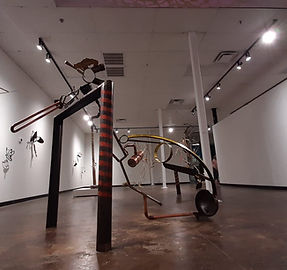
Pulling Edges
Tanner Young (2023)
Young's work addresses the relationship between objects and memory. Often acting as a marker for experiences, objects offer a method by which to navigate by serving as internal landmarks. His hybridized forms describe personal truths, events, and behaviors.
Pulling Edges consists of objects and installations composed of cast bronze, copper, steel, wood, and found objects.
About The Exhibit
Jason Tanner Young collects and utilizes copper both as a found object and as a means to produce his own bronze alloy. He is interested in an object's history (haunted materials), and its relationship and connection to a place. Copper is often used for electrical wiring, various plumbing applications (potable water, steam for warmth), or to relocate rainwater via gutters and downspouts. Young is interested in how these architectural inner workings exemplify a body and sustain daily functions that often go unnoticed.
The lost wax process is another relatively hidden application. Much like a circulatory system, the sprue and runner system is avital network that conveys hot metal to all parts of a mold. Young's sculptures embrace and accentuate this network of vessels, highlighting the elegant and complex system that helps birth so many of our everyday objects. Young incorporates these cast bronze pieces into steel and wood compositions, creating new hybridized forms.
Using locally sources wood from various places he has lived, Young usually processes and mills the wood himself from storm-damaged trees. While fragments of tools can be identified in his works, the open, twisting forms suggest the fluidity of fish or the movement of water. Recent sculptures include the process of stack lamination as a building method for the construction of works that function as internal landmarks. He thinks of landmarks in terms of navigating and measuring distance; they are nostalgic objects specific to an area and profound in the way they permeate our memory. Specifically, that silo with mesquite trees growing out of it that was torn down several summers ago, but it still exists. The memory of the experience is the true ownership.


Pink Funeral
Autumn Baugh (2023)
Pink Funeral is the exploration of identities surrounding mortality and emotion and how they each associate with color. Pink, green, blue, and yellow all have individual identities specific to our own experiences. What is a sad color? What is a happy color? What color best describes your mental state? What color do you most closely identify with your parent’s divorce when you were 9?
Colors evoke a type of catastrophic and chaotic emotion, completely unpredictable. Some colors remind us of the time we were only as tall as our grandparent’s hips as they chased behind us, struggling to catch up. Another color may remind us of the time we sobbed in silence in our cars as rain taunted our windows after the loss of a loved one. Meanwhile, some colors make us cherish the sun and remind us of how lucky we are after having to endure a natural disaster, while another color may make us reminisce about the time we first met the love of our lives. Colors have become representations of milestones in my life and upon seeing them, an amazing token of impermanence.
Each day we collectively choose to ignore our reminders of mortality, neglecting that one day our short lives will end and that our existence as we know it will blow away in the wind, meaning our names, eventually, will all be forgotten. We choose to ignore these grim reminders of death because of our tendency for self-preservation and hero archetypes, telling ourselves that we have a divine destiny or prophecy to fulfill. Does the idea of having some type of destiny give us a purpose or most likely a reason to live? A reason to be excited for the future, perhaps? What if we discovered the meaning of life and it had no meaning?
Faces of those whom I love surround you, reader, in colors I have very specifically chosen for each individual. Fun, excitement, and curiosity envelop the room as we discuss things like death and despair... but everything is pink. Cute, right?
Explore Autumn's Work:
https://www.autumnbaugh.com/
https://www.instagram.com/autumnbaugh/?hl=en
https://www.facebook.com/baughautumn


Breaking The Mold
John Chisem III (2023)
These paintings represent the journey of black women breaking the mold and stereotypes of a society that they have faced for generations. This series is intended to represent how society has visualized black women for centuries and has put them in a metaphorical bubble, or in this case stone. These paintings show a progression of a young woman going through her life and breaking free of these notions and becoming a truly independent woman. I wanted to show that not only black women, but all women can break free from these notions and become strong, independent, and successful people.


Altarpiece
Kaitlyn Johnson (2023)
Many people ask me what inspires me when I paint, and if I'm honest, I am not sure myself sometimes. I feel like I have an inherent desire to understand my emotions and painting helps me to do so. I focus mainly on negative emotions and how I personally process grief. I see my art as almost a log of past lives and eras that I have gone through, and my work acts like a time stamp of what I was going through at the time. My journey in creating Altarpiece helped me see where I am, currently, in my mental health and mindset. Personally, Altarpiece feels hopeful, and it feels like a progression from where I have been in my mental health previously. This year I found myself broken into threes: weakness, growth, and resolve, but seeing the artwork completed I interpret them differently as stages of grief.
There is not a lot of planning that goes into my painting process, and i work impulsively; landing at the first subject that "feels right", and I dissect the decision afterwards. The objects added are nostalgic and symbolic but together they all kind of feel nonsensical. I think I've done that because grief can feel absurd, complex, and confusing at times. For me, painting has helped me decipher myself and my tendencies and helps me better understand and accept my negative emotions which are natural, yet seemingly hidden, part in everyone's lives. It is a subject that everyone can connect with, being the death of a loved one, death of a past self, or death in potential.
In the end, I feel like you, a person viewing my art and trying to find connection and meaning in it all. I hope you view my art freely, without any pressure to understand it, and I hope you feel like you have the freedom to feel and process your grief.


Shaping American Architecture
Melissa B. Tubbs (2023)
Biography
Melissa B. Tubbs is an architectural portraitist. She does not create architectural renderings; rather she uses architecture as a subject. She carefully organizes the composition, adjusts the lighting for dramatic purposes, and captures the solidity, strength, textures, surface finishes, and character of her subject with the stroke of a pen.
Melissa B. Tubbs has been recognized through numerous commissions, dozens of publications, and inclusion in a variety of exhibitions from Montgomery to New York. She received a prestigious Pollock-Krasner Foundation grant for 2019-2020 in support of her traveling exhibition Andrea Palladio: Shaping American Architecture.
About the Exhibit
While each of West’s paintings are created through layers of oil paint, from afar they can often appear digital as they contain different types of spaces within the same composition and are executed with different painting “languages”. By depicting rendered figurative spaces alongside abstracted forms, the paintings point to the moment when flat abstraction transforms and is activated- be it by optical illusion, imagination or divine force. Throughout the paintings in Circuit, transitional moments are highlighted-between abstraction and illusion; between touch and response; between dying plants and living waters. These moments of tension and blurred boundaries serve to underscore the thin divide between the material and spiritual realms.
Tubbs grew up in an Air Force family that required they move every three years. Eventually her father retired in Montgomery, Alabama, so that is where Tubbs settled. She earned a bachelor’s degree in visual design from Auburn University, began a career in commercial design, and raised a family.
After 25 years of designing magazines and creating drawings and pastels on her own time, in the mid- 1990s she was offered a commission that would dramatically alter her career and her approach toward art. Her sister asked Tubbs to create an original drawing of her father-in-law’s house as a Christmas gift. This was a new challenge for the artist but it yielded surprising results. Several friends who saw the drawing ordered similar renditions of their homes. A local gift shop displayed other Tubbs drawings of historic homes. Then a local law firm commissioned Tubbs to document every courthouse in Montgomery and surrounding counties.
Tubbs soon came to the realization that this new subject engaged her interest and passion for architecture and made better use of her finely honed technical abilities. In addition to numerous commissions, Tubbs used her pen to document significant works of architecture and the decorative ornaments on those structures. Indeed, some of the artist’s finest works are of building details, focusing on architectural embellishments, different textures of building materials, and the dramatic patterns of light and shadow cascading across the surfaces of the structure.
Pen and ink drawings require careful preparation, concentration, intensity, and error free execution. Tubbs’ process begins with a camera and a zoom lens. She takes several photographs of the overall subject, and detail photographs at different exposures to document information in the area of sunlight and shadow. The basic design is sketched on paper with a graphite pencil. Concentrating on one small section at a time, she builds up layers of ink and depth through a combination of hatched and crosshatched marks until the subject is adequately defined. After all areas have been worked, she reinforces overall shadow patterns to pull all the individual areas together into a unified drawing.
For the last two dozen years, Tubbs has been a full-time artist, architectural preservationist, and community arts enthusiast. She was commissioned by the Montgomery Area Business Committee for the Arts to create drawings as awards given to outstanding business supporters of the arts. The Montgomery Museum of Fine Arts commissioned a series of eight drawings of its interior and exterior, and a few years later asked her to document a new building addition. Strathmore Artist Papers commissioned a drawing for their Series 400 Smooth Surface drawing pad covers and one for their Series 500 Bristol Board covers. In addition, she used her pen-and-ink skills to create a three-dimensional Christmas ornament for the official White House Christmas tree in 2011.


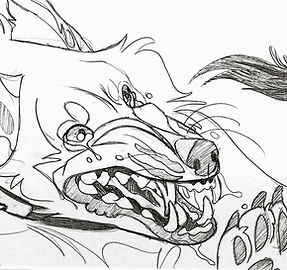
Cornucopia of Carnivora
Nigel Dean (2023)
Nigel Dean is a local high school senior at Hokes Bluff High School. She focuses on graphite drawings based on stories from her mind and feelings.

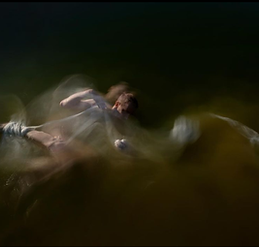

The Light Within
Ryan Carlson (2023)
My work is a reflection of the deep connection I feel to nature. I’m constantly inspired by its colors, patterns, textures, and light. Time outdoors is just as much a part of the creative process as sketching ideas or constructing pieces. My intention is not to replicate these landscapes or the flora and fauna that inhabit them. I want to take that inspiration and create something completely new — something that could exist alongside them or in its own unique world.
My current body of work is titled The Light Within. It’s rooted in the idea of transmigration, the transfer of a soul from one being to another after death. The title suggests that our souls are a light that never burns out. We all age, break down and eventually die, but that inner light lives on. Several of the pieces contain illuminated or gold leaf, chrysalis-like forms. They symbolize that inner light, our soul. Bird imagery or feathers in the work symbolizes the flight of the soul as it leaves one being to inhabit another.
I want a harmonious balance between the work’s theme and the materials/processes I use to create it. Using nuts, leaves, and fungi in the handmade paper or inks points to new life/new beginnings. Branches point to growth and aging. Bones and rust point to death and decay. Like the theme itself, the work has an entire life cycle contained within it.

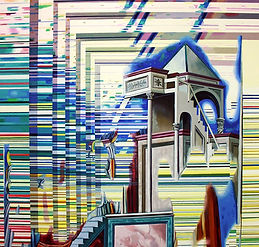
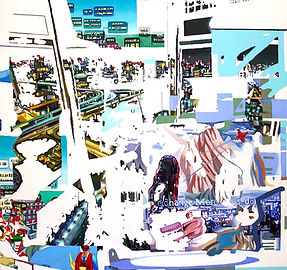
Circuit
Sarah West (Butler) (2023)
Biography
Sarah West is an artist whose work examines our persistent desire to be transported by visual means and explores ways the spiritual realm has been represented in the past and today. Her recent body of work aligns Early Renaissance painting compositions and digital spaces in their shared role as dream spaces/sites of spiritual quests. Mysterious codes, idealized forms, and narratives of progress cloud the digital landscape referenced, all pointing to deep human longings- for transcendence, transformation, and enlightenment. The resulting paintings evoke a divine encounter, reflecting on both the religious subject matter referenced in Renaissance sources and the mystical aura surrounding new technologies.
Artist Statement
While each of West’s paintings are created through layers of oil paint, from afar they can often appear digital as they contain different types of spaces within the same composition and are executed with different painting “languages”. By depicting rendered figurative spaces alongside abstracted forms, the paintings point to the moment when flat abstraction transforms and is activated- be it by optical illusion, imagination or divine force. Throughout the paintings in Circuit, transitional moments are highlighted-between abstraction and illusion; between touch and response; between dying plants and living waters. These moments of tension and blurred boundaries serve to underscore the thin divide between the material and spiritual realms.